
![Summer Chicken Care | Ultimate Guide [2026]](http://milefour.com/cdn/shop/articles/Chicken_Guide_for_Summer_ec738b5a-ed28-4f18-b522-28c5f57036d1.webp?v=1780955954&width=3000)
Summer in the backyard flock world means early mornings, louder clucks, and more than a few side-eyes from hens annoyed by the heat. Chickens are remarkably adaptable. That doesn't mean summer is a breeze. From heat stress to egg spoilage to all the creepy crawlies that come out to play, this season requires a few smart shifts in your routine.
This guide covers what matters most during the warmer months. Let's get your hens through it.
Chapter 1: Heat-Tolerant Chicken Breeds
Chapter 2: Summer Chicken Coop Setup
Chapter 3: Summer Nutrition & Hydration
Chapter 4: Pests & Parasite Prevention
Chapter 5: Summer Egg Care & Behavior
Heat Tolerant Chicken Breeds

Just like some people run hot or cold, so do chickens. Chicken breed matters when the mercury rises. The difference comes down to body mass, feather density, and comb size.
Combs aren't just decorative. They're packed with blood vessels, and when it's hot, those vessels dilate to push heat out of the bird's body into the air. The bigger the comb, the more surface area for that heat exchange. Mediterranean breeds like Leghorns, Minorcas, and Andalusians were developed in warm climates. They're naturally leaner, carry less insulating fluff, and have the large combs to match. Easter Eggers and Rhode Island Reds are solid middle-ground options. Not as lean as Mediterraneans, but well-adapted across a wide range of temperatures.
Live somewhere humid or regularly hitting triple digits? Those breeds are your starting point.

On the flip side, fluffier, heavier breeds like Brahmas and Cochins struggle in heat waves for the same reason they thrive in winter. All that insulation works against them in summer. Their smaller, more compact combs also limit heat release. If they're part of your flock, extra shade, airflow, and cold water access aren't optional. They're essential.
🔍 Pro tip: Breed tolerance has a ceiling. A Leghorn in a poorly ventilated coop with no shade will still overheat. Breed gives you a head start. Your setup does the rest.
Summer Chicken Coop Setup
Your coop should protect your chickens from predators, yes. But in summer, it also needs to breathe.
Ventilation is the single most important thing you can do for a hot coop. Without airflow, heat builds fast, humidity spikes from droppings and the birds' own respiration, and ammonia levels rise. All of which stresses a flock even before temperatures get dangerous. Keep vents open high on the walls where hot air naturally collects. Allow cooler air to draw in from lower openings. Cross-ventilation (air actually moving through the coop, not just in) is what you're after. More insulation is not the answer this season. Airflow > airtight.
Shade makes a big difference too. The coop itself can become an oven if it's sitting in full sun all afternoon. Tarps, old sheets, shade cloth over the run, or a trellised vine all make a real dent. Got a metal roof? It absorbs and radiates heat far more than wood. Consider painting it white or adding a radiant barrier inside to reduce heat transfer.
READ: Chicken Coop Bedding Guide
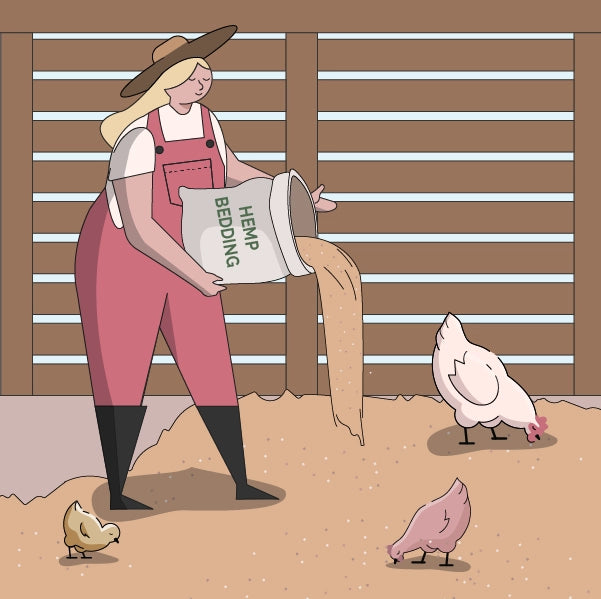
When it comes to bedding, skip deep litter in summer. The composting process in deep litter generates heat. Great in January. Miserable in July. Opt for clean, dry material like hemp bedding or sand. Hemp stays drier than straw, resists bacterial growth, and manages moisture and odor well. Both of which escalate fast in warm weather. Spot-clean under roosts daily, and plan on a full bedding swap every one to two weeks during peak summer.
Summer Nutrition & Hydration
Hot weather? Chickens will let you know. Panting, wings held out from the body, slow movements. It's their version of flopping in front of a fan.
Water is the non-negotiable first fix. Chickens pant to cool down, and panting burns through water fast. A drop in intake can quickly affect egg production, digestion, and overall health. When temps climb into the upper 80s and above, hens can drink close to twice their normal daily amount. Refill waterers 2-3 times a day, keep everything shaded so the water stays cooler, and use wide open bowls alongside nipple drinkers. A nipple system alone is too slow for a bird that genuinely needs to tank up in the heat.

Want to take it further? Float ice packs or frozen water bottles in the waterer to drop the temp. Offer frozen watermelon chunks or peas. High water content, and most hens go after them fast. Hydration & enrichment in one move.
When it comes to feed, chickens naturally eat less during the hottest part of the day. That's normal. Digesting feed generates internal heat, so they instinctively back off when it's sweltering. Work with that, not against it:
Serve layer mash or pellets in the morning or evening, not the heat of the day.
Wet mash or fermented feed adds moisture to every bite and supports digestion. Worth considering when you want to boost intake without forcing it.
Skip midday feeding when temps peak. Chickens won't be interested anyway.
On electrolytes: heat causes birds to lose sodium & potassium through panting. A poultry-formulated electrolyte mix in the water (not a sports drink, the ratios are different) helps replace what they lose during heat waves. Use it on hot stretches, not every day.
Pests & Parasite Prevention
Summer is prime time for things that bite, burrow, buzz, or otherwise bug your birds.
Two mites worth knowing by name: northern fowl mites spend their entire life cycle on the bird, day & night, and show up as tiny dark specks crawling near the vent or under the wings. Red mites are trickier. They hide in coop crevices, roost bars, and nesting areas during the day and come out to feed at night. If your hens seem restless on the roost, you're seeing pale combs, or production has dropped without explanation, check after dark with a flashlight. Red mites are nearly impossible to catch otherwise.
Lice are also full-time residents on the bird. They cluster at the base of feathers near the vent and under the wings. They don't affect eggs or people, but a heavy load stresses birds and chips away at production.
How to stay ahead of it:
Use food-grade diatomaceous earth in bedding and dust baths. Food-grade matters. Pool-grade DE is heat-treated and contains crystalline silica, which can cause respiratory damage. Food-grade works by physically damaging insects' exoskeletons, not chemically. It needs to stay dry to stay effective.
Treat roost bars and crevices with diluted neem or peppermint oil. Common deterrents for red mites in particular.
Scoop droppings from under roosts daily or use poop boards for easy cleanup.
Swap out bedding before it gets damp or clumpy. Moisture is where pest problems compound fast.
Chickens also self-manage parasites through a good dust bath. The fine particles work into the feathers and disrupt surface-dwelling insects. Set one up using dry dirt, sand, and wood ash in a kiddie pool, old tire, or shaded pit. If the soil in your run stays wet or packed, a dedicated dry spot is a necessity, not a bonus.
Watching them flop around like tiny dinosaurs in a spa is free entertainment.
Summer Egg Care & Behavior
Let's clear up a common summer myth: more daylight doesn't always mean more eggs.
Laying is metabolically demanding. When a hen is burning energy to regulate her body temperature, less is available for egg production. Add reduced feed and water intake on hot days, and a drop in laying is the predictable result. It's not a problem to solve. It's a seasonal pattern to expect.
A few things help keep production as steady as possible:
Keep the coop cool and nest boxes shaded. A hot, stuffy nest box discourages laying and sends hens looking for somewhere cooler.
Collect eggs at least 2-3 times daily. In 90°F+ heat, an egg left in a warm nest box can reach unsafe internal temperatures faster than most people expect. Shells also become more fragile as heat cycles through them.
Keep free-choice oyster shell available. Shell quality slips in summer when calcium intake is inconsistent.
Then there's the stress molt that shows up mid-summer. Sustained heat, disrupted sleep from longer days, or a rough heat wave can trigger partial feather loss outside the normal fall cycle. It looks alarming, but it's the same process. The bird redirects protein toward feather regrowth instead of eggs. Feathers are roughly 85% protein, so a molting bird needs more of it. Scrambled eggs, black soldier fly larvae, or a temporary boost in dietary protein helps move it along. The molt typically resolves in a few weeks once conditions stabilize.

READ: Ultimate Chicken Feed Guide
On behavior: chickens range less in peak heat, spending more time in shade and less time foraging. That's thermoregulation, not boredom. But if they're confined to a small run, they still need something to do. Feather-pecking tends to increase when birds are hot, crowded, and understimulated.
Hang a cabbage head or corn cob for pecking.
Toss frozen treat blocks (fruit & water frozen in a container) into the run.
Scatter morning scratch in different spots to encourage foraging during the cooler part of the day.
Enrichment for them. Less chicken drama for you.
One Last Thing Before Summer Gets Serious
Heat, pests, and a dip in laying are all predictable. None of them have to derail your flock. The difference between a rough summer and a smooth one usually comes down to a few small habit shifts made early.
Make sure you've got the basics covered: fresh organic feed, grit, & oyster shell. Clean, shaded water. That's most of the work right there.
Sources: University of Minnesota Extension — Managing & Preventing Heat Stress in Poultry (extension.umn.edu); Alabama Cooperative Extension System — Poultry Red Mites: Identification, Prevention & Treatment (aces.edu); Mississippi State University Extension — Northern Fowl Mite Management (extension.msstate.edu); Virginia Tech VCE Publications — Poultry Parasites: Northern Fowl Mites (pubs.ext.vt.edu); ScienceDirect — Effect of Partial Comb & Wattle Trim on Pullet Thermoregulation (sciencedirect.com); Frontiers in Veterinary Science — Alleviating Heat Stress Effects in Poultry (frontiersin.org); The Poultry Site / University of Georgia Cooperative Extension — Feather Loss in Chickens (thepoultrysite.com)
Disclaimer: Mile Four is not a veterinary service. This content is for educational purposes only. Consult a licensed poultry veterinarian for flock health concerns.