

If you have spent any time comparing chicken feed, you have probably noticed that corn & soy appear on a lot of ingredient lists.
Then you find a bag labeled corn-free & soy-free, usually at a higher price, & the obvious question comes up:
Does avoiding corn & soy actually make the feed better?
Not automatically. Corn & properly processed soybean meal can both be useful ingredients in a complete poultry ration. A corn-free & soy-free formula can also work very well, but only when those ingredients are replaced thoughtfully & the finished feed still meets the flock's nutritional needs.
For many chicken keepers, choosing a corn-free & soy-free feed is less about treating corn or soy as dangerous & more about ingredient preferences, sourcing, transparency & the kind of formula they want to feed every day.
Why Corn & Soy Are So Common in Chicken Feed
Corn & soybean meal are often used together because they handle two different jobs.
Corn is mainly an energy ingredient. It supplies starch & calories that help chickens maintain body condition, stay active & support growth or egg production.
Soybean meal is mainly a protein ingredient. It provides concentrated protein & contributes important amino acids, including lysine.
That combination is widely used because the ingredients are available at large scale, familiar to feed formulators & relatively cost-efficient.
Common does not mean nutritionally useless.
It also does not mean every corn-&-soy formula is identical. Ingredient quality, processing, nutrient balance, freshness & the rest of the formula still matter.
The same is true on the other side. A feed does not become complete simply because the front of the bag says corn-free or soy-free.
Is Corn Bad for Chickens?
Corn is not inherently bad for chickens.
It is an energy-dense grain that can play a useful role in a properly balanced ration. The problem comes when corn is treated as though it can provide everything a chicken needs by itself.
It cannot.
Corn is not a complete feed. It does not supply the full balance of protein, amino acids, vitamins & minerals required by chicks, growing pullets or laying hens.
This is why a handful of cracked corn is a treat or supplemental food, not a replacement for a complete ration.
Feeding large amounts of corn, scratch grains or other extras can dilute the nutrition of the main feed if chickens fill up on them first.
The useful question is therefore not:
Does this feed contain corn?
It is:
Does the complete formula provide the right energy & nutrition for this flock's life stage?
Why Do Some Keepers Choose Corn-Free Feed?
People avoid corn for several different reasons, & they are not all nutritional.
Some want a formula built around a wider mix of grains. Some prefer certified organic or Non-GMO sourcing. Others simply want to know exactly which ingredients are doing the work inside the bag.
A keeper may also choose corn-free feed because:
- They prefer wheat, barley, oats or other grains
- They want a more specialized formula
- They are trying to avoid ingredients common in conventional commodity feed
- Their flock eats another formula more consistently
- Ingredient sourcing matters to their household
Those are reasonable preferences.
What we would avoid is assuming that removing corn alone guarantees better health, better eggs or better laying.
The rest of the formula still has to do the job corn was doing.
What Replaces Corn in Chicken Feed?
A corn-free feed still needs enough energy.
Depending on the formula, that energy may come from ingredients such as:
- Wheat
- Barley
- Oats
- Sorghum
- Rice or rice-based ingredients
- Flax or other oilseeds
- Approved fats or oils
These ingredients do not behave exactly like corn.
They differ in energy, fiber, protein, amino acids & how easily chickens digest them. A formulator cannot simply remove 100 pounds of corn & add 100 pounds of barley without checking what changed across the entire ration.
That is why the guaranteed analysis matters more than the ingredient headline.
A good corn-free feed should still deliver enough energy for the age & production stage of the birds eating it.
Is Soy Bad for Chickens?
Properly processed soybean meal is not automatically harmful to chickens.
It is one of the most widely used protein ingredients in poultry nutrition because it supplies concentrated, digestible protein & useful amino acids.
Raw soybeans are different.
They naturally contain compounds such as trypsin inhibitors that can interfere with protein digestion. Commercial heat processing is used to reduce those antinutritional factors before soybean meal is included in poultry feed.
This is one reason whole raw soybeans should not be casually added to a homemade chicken ration.
Processing quality matters. So does the balance of the finished diet.
Research in laying hens has shown that soybean-based diets can support normal performance, bone strength & egg quality when the ration is properly formulated.
Choosing soy-free feed can still make sense. It just should not depend on the claim that all soy causes deficiencies or poor flock health.
Why Do Some Keepers Avoid Soy?
For many keepers, the decision is about preference rather than a proven problem in the flock.
Common reasons include:
- Wanting feed made without soybean meal
- Preferring other protein sources such as peas or sunflower meal
- Choosing certified organic & Non-GMO ingredients
- Wanting a specifically named ingredient list
- Trying a different complete formula after poor acceptance of another feed
- Personal household preferences around soy
Some people also avoid soy because they believe soy-fed hens produce eggs that will trigger soy reactions in people.
That is not a safe assumption to build a medical decision around.
A soy-free feed label does not guarantee that eggs are appropriate for someone with a soy allergy, & it should not be marketed as an allergy treatment. Anyone managing a food allergy should follow guidance from a qualified medical professional rather than relying on a poultry-feed claim.
What Replaces Soybean Meal?
Soy is harder to replace than many people expect because the replacement has to cover more than one protein percentage.
Chickens need individual amino acids in the correct amounts, including lysine & methionine. Two feeds can both contain 16% crude protein while providing different amino acid profiles.
Soy-free formulas may use combinations of:
- Field peas
- Sunflower meal
- Canola meal
- Rice protein
- Flax meal
- Fish meal
- Alfalfa meal
- Yeast ingredients
- Supplemental amino acids when needed
None of these is a perfect one-for-one substitute for soybean meal.
Peas may contribute protein & lysine but still need support elsewhere in the formula. Sunflower meal has a different fiber & amino acid profile. Fish meal can provide useful protein but must be used carefully for consistency, quality & palatability.
The finished feed matters more than whether one alternative ingredient sounds wholesome on its own.
Does Corn-Free & Soy-Free Feed Improve Flock Health?
There is no universal evidence that every flock becomes healthier simply because corn & soy are removed.
A balanced corn-&-soy feed can support healthy chickens.
A balanced corn-free & soy-free feed can support healthy chickens too.
A poorly balanced version of either one can cause problems.
When comparing feeds, pay closer attention to:
- Whether it is a complete feed
- The intended species & life stage
- Crude protein
- Lysine & methionine
- Calcium & phosphorus
- Fat & fiber
- Vitamin & mineral supplementation
- Ingredient specificity & sourcing
- Whether the flock consistently eats the complete ration
Our guide to reading a chicken feed label explains how to compare the guaranteed analysis & ingredient list without needing a poultry nutrition degree.
Does Corn-Free or Soy-Free Feed Change the Eggs?
What hens eat can affect certain characteristics of their eggs.
Diet can influence yolk color, fatty acid composition &, when nutrition is inadequate, shell quality or laying performance.
That does not mean removing corn or soy automatically produces a healthier egg.
Yolk color is a good example.
Corn contains yellow pigments that can deepen yolk color. Corn-free formulas can still produce golden or orange yolks when they include other pigment sources such as alfalfa, marigold or green forage.
A darker yolk is not proof that one feed is nutritionally superior. It mainly shows which pigments the hen ate.
Our guide to what actually controls egg yolk color goes deeper into the role of feed, forage & individual hens.
Soybean ingredients can also influence egg fatty acid composition depending on the type of soybean & fat in the formula. That is different from showing that soy-free eggs are automatically safer, cleaner or more nutritious.
Who Is Corn-Free & Soy-Free Feed Best For?
It may be a good fit when you:
- Prefer a formula built around other grains & protein sources
- Want USDA Organic or Non-GMO sourcing
- Care about clearly named ingredients
- Want to know where major ingredients come from
- Are comfortable paying more for a specialized formula
- Have found a complete corn-free & soy-free feed your flock eats well
It may matter less when your current feed is complete, appropriate for the flock's age, consistently eaten & working well for your priorities.
You do not need to change a healthy flock's diet because a different label sounds cleaner.
Make the decision based on the whole formula & what matters to you, not fear around one ingredient.
How to Compare Corn-Free & Soy-Free Chicken Feeds
The front of the bag tells you what the feed leaves out.
The back tells you whether the rest of the formula makes sense.
What to check before switching
- Confirm that it is complete feed. Treats, scratch grains & supplements are not replacements for a balanced daily ration.
- Match it to the life stage. Starter, Grower & Layer formulas have different protein & calcium targets.
- See what replaces the corn. Look for a sensible combination of energy ingredients such as wheat, barley or oats.
- See what replaces the soy. Look for multiple protein sources & guaranteed lysine & methionine values.
- Read the complete guaranteed analysis. Protein alone does not tell you whether the ration is balanced.
- Check the certifications. Corn-free, soy-free, organic & Non-GMO are separate claims.
- Watch the flock during the transition. Appetite, droppings & feed waste can change when the ingredients or feed form change.
Organic, Non-GMO, Corn-Free & Soy-Free Do Not Mean the Same Thing
These terms are often printed beside one another, but they describe different things.
- Corn-free means the formula does not contain corn ingredients.
- Soy-free means the formula does not contain soy ingredients.
- Non-GMO refers to the genetic-engineering status of ingredients.
- USDA Organic covers a broader certified production standard, including how agricultural ingredients are grown & processed.
A conventional corn-free feed may still contain other genetically engineered ingredients.
An organic feed may contain organic corn or organic soybean meal.
A corn-free & soy-free formula is not automatically organic.
Decide which distinction you actually care about, then verify it on the label rather than treating all four phrases as interchangeable.
How Mile Four Formulates Without Corn or Soy
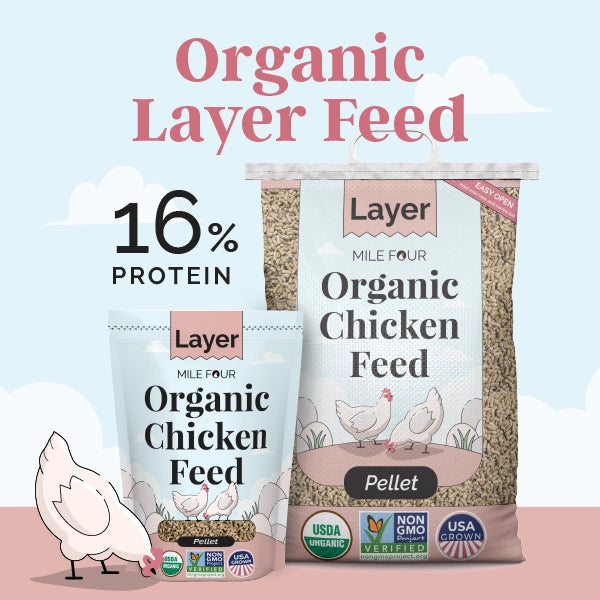
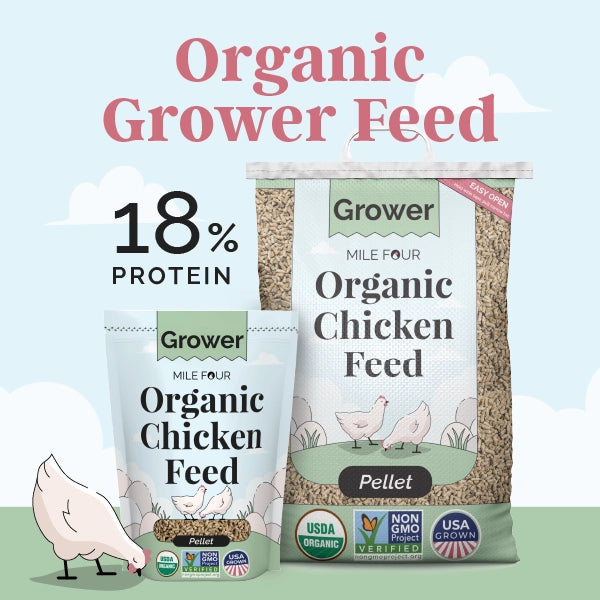
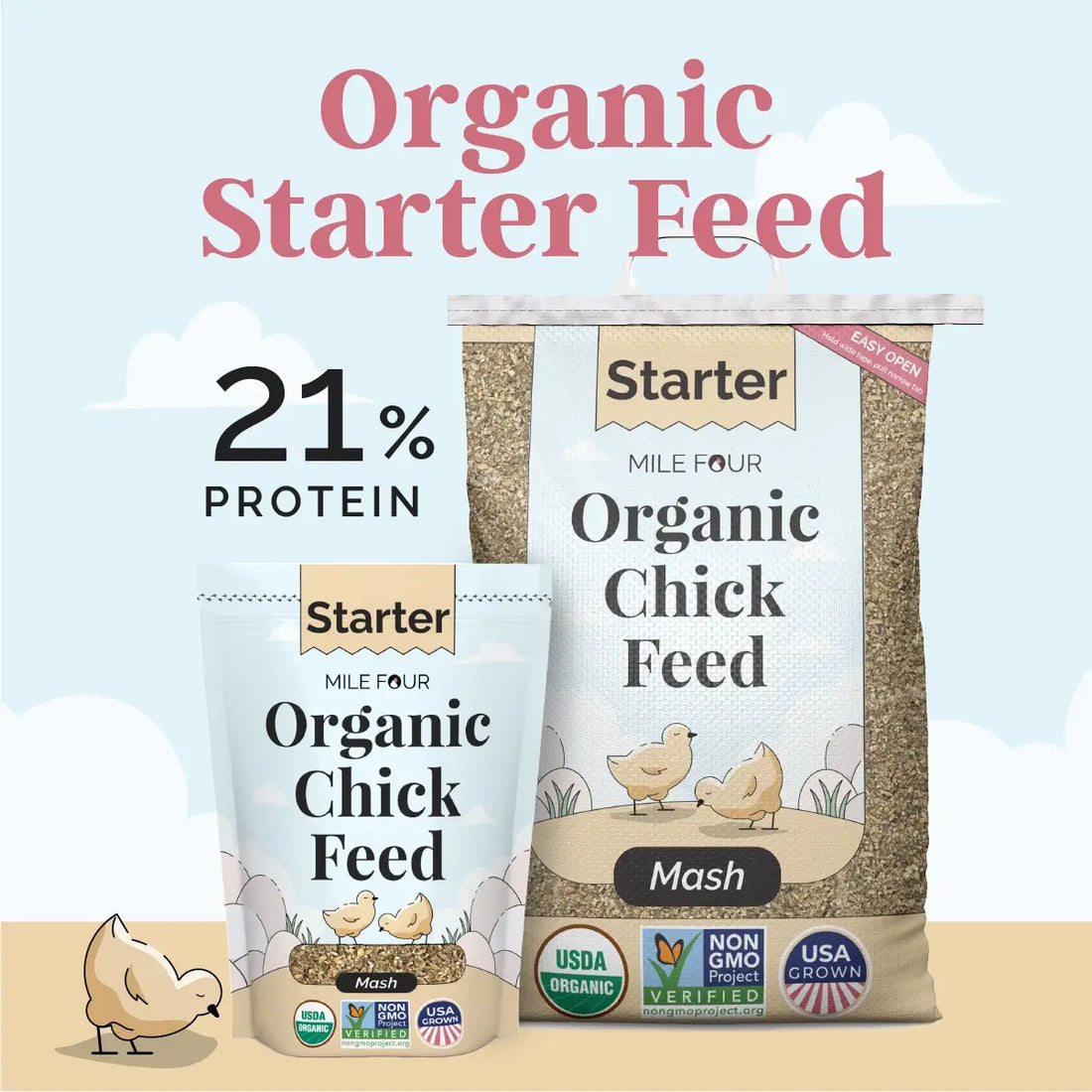
Mile Four Starter, Grower & Layer feeds are formulated without corn or soy.
Instead, the formulas use combinations of ingredients such as organic wheat, barley, peas, sunflower meal, alfalfa meal, flax meal, rice protein, fish meal & yeast ingredients, depending on the feed stage & form.
The exact recipe is adjusted because chicks, growing pullets & laying hens do not need the same balance.
- Starter Feed is formulated with higher protein for early growth.
- Grower Feed supports developing pullets before lay.
- Layer Feed includes the higher calcium needed by laying hens.
The feeds are also USDA Organic, Non-GMO & made with U.S.-grown grains sourced from family farms.
That combination is the value proposition.
Not that corn & soy are incapable of feeding chickens, but that some keepers prefer a complete formula built without them & want the sourcing & ingredients clearly identified.
Switch Gradually, Even When the New Feed Looks Better on Paper
Chickens tend to notice when their feed changes.
A new formula may smell different, feel different or contain particles the flock has not seen before. An abrupt change can also affect feed intake or droppings while the birds adjust.
Mix the old & new feed gradually over several days, increasing the new feed as the flock continues eating normally.
Watch for excessive sorting, large amounts of fines being left behind or lower-ranking birds losing access to the feeder.
Feed form matters here too. Mash, pellets & whole grain can create very different eating behavior even when the nutritional purpose is similar.
If you are comparing formats, read Whole Grain vs. Mash vs. Pellets vs. Crumbles.
Is Corn-Free & Soy-Free Chicken Feed Worth It?
It can be, when the formula & the priorities behind it make sense for you.
You may decide it is worth paying more for organic sourcing, named ingredients & a formula made without corn & soy.
Another keeper may choose a well-formulated corn-&-soy feed & have a healthy, productive flock.
Neither label settles the question by itself.
The useful comparison is between complete formulas, not isolated ingredients.
Check what supplies the energy. Check what supplies the protein & amino acids. Match the feed to the flock's age. Then decide whether the sourcing, ingredient choices & price fit the way you want to keep chickens.
That is a much stronger reason to choose a feed than simply being told one common ingredient is bad.
To compare Mile Four's corn-free & soy-free options, explore Organic Chicken Feed in Starter, Grower & Layer formulas.
Sources
- Merck Veterinary Manual, “Nutritional Requirements of Poultry”: Energy, amino acid, vitamin & mineral requirements, including the use of corn-soybean meal diets as common formulation references.
- University of Kentucky Extension, “Soybeans in Poultry Diets”: Soybean meal nutrient composition, common use in poultry feed & heat treatment of trypsin inhibitors.
- University of Kentucky Extension, “Protease Inhibitors”: Trypsin inhibitors in raw legumes & the role of heat processing before soy is used in poultry diets.
- USDA Agricultural Research Service, laying-hen soybean meal study: Egg quality, bone strength, nutrient digestibility & egg fatty-acid outcomes in hens fed several soybean-based diets.
- USDA Agricultural Research Service, soybean processing study: Trypsin inhibitors, soybean-meal processing & poultry performance.
- Mile Four, “How to Actually Read a Chicken Feed Label”: Guaranteed analysis, ingredient lists, life-stage nutrition & feed-label terminology.
- Mile Four Organic Layer Feed product information: Current ingredients, guaranteed analysis, certifications & corn-free & soy-free formulation details.
This article provides general educational information about poultry feed ingredients. Corn-free & soy-free do not automatically mean nutritionally complete, organic, Non-GMO or suitable for every life stage. Follow the feeding directions & guaranteed analysis on the product label. Feed choices should not be used to diagnose or treat human food allergies or medical conditions.