

Every backyard chicken group has that one thread. Someone spots "flax" or "flaxseed meal" on a feed label & asks whether it belongs there at all. A few replies later, the thread has covered fishy eggs, cyanide, & feed going rancid, all in the same breath.
The questions come from a real place. Flax behaves differently than corn or wheat once it's milled into feed. But most of what circulates about it mixes up a few unrelated things: research trials that test flax at levels no feed maker would use, & one claim that has nothing to do with flax at all.
What Flax Actually Is (& Why It Ends Up in Chicken Feed)
Flax is a seed crop, best known as one of the richest plant sources of alpha-linolenic acid (ALA), an omega-3 fatty acid. Hens convert dietary ALA into the omega-3s that end up in the yolk. Translation: a hen is a small, feathered omega-3 factory.
Flax shows up in feed in three forms, & the differences matter more than the ingredient panel lets on.
Think of it like almonds: whole, ground into flour, or pressed for oil. Same seed, three different outcomes, & the pressed version is the fastest to spoil.
Whole flaxseed has a hard outer coat. Most of it passes through a hen's digestive tract without being broken down.

Flax meal is flaxseed that's been ground, usually by cold-press or hot-press methods. Grinding makes the ALA & other nutrients available for absorption, which is why most complete feeds use this form.

Flax oil is the extracted fat: concentrated ALA with none of the seed's fiber. It's also the form most prone to going rancid, since the compounds that protect the whole seed are gone.

None of these forms show up alone in a feed bag. They're one ingredient among many in a complete formula, alongside everything else a flock needs. For how the rest of those pieces fit together, see The Ultimate Chicken Feed Guide. With that context set, here's where the actual myths fall apart.
1. Myth: "Flax makes eggs taste fishy"
Fishy-tasting eggs are a real, documented issue. Flax isn't the cause of it.
The actual cause is canola meal, combined with a recessive gene mutation some brown-egg layers carry. Hens with that mutation can't break down a compound called trimethylamine, which builds up in the yolk & causes the smell.
It's a bit like a food sensitivity. Every hen at the feeder eats the same thing, but only the ones carrying that gene ever react.
Flax doesn't enter into the mechanism at all. If eggs taste off, canola meal in the ingredient list is the one worth checking. Flax isn't.
2. Myth: "Flaxseed has cyanide in it"
Flaxseed does contain small amounts of naturally occurring compounds called cyanogenic glycosides. Broken down in large enough amounts over a long period, they can release hydrogen cyanide. Stated on its own, that sounds alarming.
In context, the levels are low, & flax isn't unusual for having them. Apple seeds contain a form of the same compound. Nobody skips apples over it, because the amount is small.
Flax meal works the same way. A 2022 review in the journal Agriculture puts its cyanogenic glycoside content at roughly 400 mg/kg, & grinding & pressing reduce that further. The same review found no adverse effects in laying hens at inclusion levels up to 10%, far above what flax makes up in a complete feed.
3. Myth: "Flax ruins the feed with rancidity"
This is the one myth with real substance behind it, worth taking seriously rather than waving off.
Flax's fat is unusually rich in polyunsaturated fatty acids, which oxidize faster than the saturated fat in most other feed ingredients. It's the same reason a cut avocado browns in an afternoon, while a whole one keeps for days.
That's why form matters. Flax meal, milled & used within a feed's normal shelf life, holds up fine. Flax oil, once extracted & exposed to air & heat, is the "cut avocado" of the two.
It's a freshness & processing question, not a reason to avoid flax altogether.
4. Myth: "It's a cheap filler ingredient"
The research says the opposite. Feeding flaxseed to laying hens has repeatedly been shown to raise the omega-3 content of eggs several times over, in some studies to a level comparable to eating a serving of cold-water fish.
Calling that filler is like calling the yeast in bread filler. It's not the ingredient anyone notices first, but pull it & the loaf falls flat.
Where the Caution Actually Comes From
So is the worry made up? Not entirely. None of the myths above hold up, but the instinct behind them isn't paranoia.
Research has found real downsides at high inclusion levels. Egg production & shell quality can decline once flax passes roughly a fifth of a hen's total diet.
In broilers, weight gain can suffer above 5 to 10% inclusion, with one study recording an 8% drop in body weight at 15%. A separate study in the Canadian Journal of Animal Science tracked flaxseed's effect on body weight, reproductive performance, & hatchability across a full breeding cycle.
Here's the catch: those numbers come from trials that push flax to a large share of the diet on purpose, to isolate its effect. Imagine judging a diet by the one day someone ate nothing but kale. Technically real. Not anyone's actual dinner plate.
A complete, balanced feed doesn't work that way. Flax sits alongside organic grains, protein, & minerals, one ingredient among many rather than the whole diet.
Formulation has its own tools for the rest of it. Extension research notes that added vitamin E can offset flax's oxidative stress, & the same 2022 review found that added enzymes reduce its antinutritional effects even at research-trial inclusion levels.
The Bottom Line
Flax's reputation problem is mostly a mix-up: research tested at doses no feed maker would use, a fishy-egg myth that belongs to a different ingredient, & a real freshness question that comes down to processing, not the ingredient itself.
Used the way it actually shows up in a feed bag, ground into meal, in modest amounts, alongside everything else a flock needs, flax is doing exactly the job it's there for.
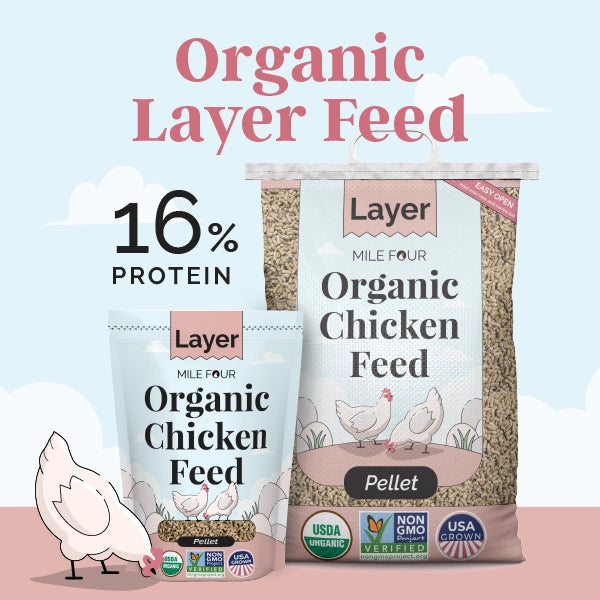
Every format of Mile Four's Layer Feed, Whole Grain, Pellet, & Mash, includes organic flax meal (Whole Grain also adds organic flax oil), part of a complete, corn-free, soy-free, Non-GMO formula rather than an isolated ingredient.
Sources:
- Flax Seed in Poultry Diets (Cooperative Extension, poultry.extension.org). Covers inclusion levels, omega-3 enrichment, & the liver-hemorrhage caveat at prolonged high inclusion.
- Including Flax Seed in Organic Poultry Diets (eOrganic/eXtension). Covers 10% vs. 15% inclusion effects on egg production in layers.
- Pi et al. (2022), "Flaxseed Meal and Its Application in Animal Husbandry: A Review," Agriculture (MDPI). Covers cyanogenic glycoside & phytic acid content, & inclusion-rate thresholds for layers & broilers.
- Fishy-egg tainting is recessively inherited when brown-shelled layers are fed canola meal (ScienceDirect/PubMed). Covers the FMO3 gene & canola-meal mechanism behind fishy-tasting eggs.
- "The effect of feeding flaxseed as a source of omega-3 fatty acids to broiler and layer breeders..." (2024), Canadian Journal of Animal Science. Covers body weight, reproductive performance, & hatchability effects over a full production cycle.
This post is for general educational purposes & is not a substitute for veterinary care or professional guidance specific to your flock.