

Walk into any feed store and you'll see the same three words on half the bags: organic, natural, non-GMO.
They sound like they mean roughly the same thing. They don't. And figuring out which one actually matters takes more than reading the front of the bag.
Here's what each label actually covers, what conventional feed contains that won't show up anywhere on the packaging, & whether switching to organic is worth the price difference.

What "Organic" Actually Means on a Feed Label
USDA Organic is a federally regulated certification. Not a vibe. Not a marketing choice. An actual legal standard with inspections, paperwork, & consequences if you don't comply.
To carry that seal, every grain in the feed has to come from certified organic farmland. And that farmland has to have been clean of synthetic pesticides, herbicides, & fertilizers for at least three years before the first certified harvest. Not three months. Three years.
Think of it like this: if a neighbor sprayed their field with herbicide last spring and decided to "go organic" this season, they can't sell it as organic yet. The soil has to earn it back first.
"Natural" is a different story. The USDA definition says a natural product has no artificial ingredients & has been minimally processed. That applies to the final product, not to how the grain was grown. A bag labeled "natural" can legally contain grain sprayed with pesticides & grown from GMO seed. No certification. No inspection. No paper trail. Just a word on a bag.
Two bags can look nearly identical on a shelf. One required years of documented soil history to earn its label. The other required a graphic designer.
| Label | What It Covers | What It Doesn't |
|---|---|---|
| USDA Organic | No synthetic pesticides, herbicides, or fertilizers. No GMO seed. No antibiotics or growth hormones. Annual inspections required. | Doesn't specify where the grain was grown or how fresh it is. |
| Non-GMO | No genetically modified seed used. | Conventional pesticides & herbicides still allowed. No soil requirements. No inspection process. |
| Natural | No artificial ingredients in the final product. Minimally processed. | Says nothing about how the grain was grown. GMO & pesticide-treated grain is permitted. |
What's in Conventional Feed (That the Label Doesn't Mention)
Most conventional chicken feed is built around corn & soybean meal. Both are solid, affordable protein & energy sources for poultry. No argument there.
The issue isn't the corn. It's where the corn came from & what happened to it before it ended up in the bag.
More than 80 percent of U.S. corn & soybeans are grown from genetically modified seed, engineered mainly to tolerate high applications of herbicides, particularly glyphosate. That herbicide doesn't disappear at harvest. It ends up in the grain. A study in Scientific Reports found glyphosate residues to be common in conventional eggs from grocery stores, & found a statistically significant negative association between glyphosate residue levels in feed & egg hatchability. The levels were below regulatory limits. The residue is still there.

Many conventional starter feeds also come with something extra mixed in: a coccidiostat. It's a medication added to prevent coccidiosis, a common intestinal parasite in young birds. It works. It's also not something you'd choose to add yourself if someone handed you the ingredient list and asked. Permitted in conventional feed. Prohibited in certified organic.
Then there's the thing that doesn't show up on any label at all: mycotoxins. These are toxic compounds produced by mold on grain, particularly corn, that develops in storage & during transit. Picture grain sitting in a commodity silo for months before it gets milled. One study analyzing 328 corn samples from grain elevators & farms across the southeastern U.S. found that 100 percent were contaminated with fumonisin. Not most. Not many. All of them. A separate study on actual poultry feed & feed ingredients from the same region found 86 percent positive for fumonisin & 45 percent for deoxynivalenol across 572 samples.
Even at low levels, mycotoxins can reduce feed efficiency, compromise growth rates, & impair immune function. This isn't a chemical issue. It's a freshness issue. Mold grows on grain that sits too long. Grain milled fresh from a known source has less time to develop it. Conventional commodity grain has no freshness clock on the label because there isn't one.
Non-GMO Isn't the Same as Organic
This is the one that surprises people most.
Non-GMO sounds thorough. It sounds like it covers the bases. And it does cover one base: the seed. That's it. The grain wasn't grown from genetically modified seed. Everything else: the pesticides sprayed on it, the herbicides, the fertilizers, the medications mixed into the finished bag. None of that is restricted by a non-GMO certification.
It's a bit like buying "no artificial colors" cookies and assuming they're also sugar-free. The label is accurate. It just doesn't mean what you hoped it meant.
Organic is always non-GMO. Non-GMO is not always organic. The overlap only goes one direction, & the gap between them is larger than most people expect.
| Conventional | Non-GMO | USDA Organic | |
|---|---|---|---|
| No GMO seed | ✗ | ✓ | ✓ |
| No synthetic pesticides | ✗ | ✗ | ✓ |
| No coccidiostats | ✗ | ✗ | ✓ |
| 3-year soil transition required | ✗ | ✗ | ✓ |
| Annual inspections | ✗ | ✗ | ✓ |
| No growth hormones or antibiotics | ✗ | ✗ | ✓ |
Does It Actually Affect the Hens?
Large-scale research specifically on backyard flocks is still limited. Most studies focus on commercial operations. But what consistently shows up: pesticide residues carry through into eggs, mycotoxin exposure affects immunity & production, & removing coccidiostats supports healthier gut development in young birds from the start.
Keepers who switch to organic often notice steadier lay cycles & stronger shells over time. That's not a controlled trial, but patterns across thousands of backyard flocks aren't nothing either.

The bigger picture is this: the benefit of organic feed isn't dramatic or immediate. It's cumulative. Fewer unknowns going in means fewer problems to trace later. If a hen isn't laying well, isn't growing right, or keeps having soft shells, the feed is usually one of the first things worth examining. Cleaner inputs give fewer places for the problem to hide.
So Is It Worth the Price?
For most backyard keepers, yes. Here's why.
The people who get chickens because they care about what goes into their eggs are exactly the people for whom the label matters most. If you're keeping hens so you know where your food comes from, it's worth knowing where their food comes from too.
Organic is the only label with a verified paper trail from the soil to the bag. The land, the inputs, the handling, the milling: all documented, all inspected. That's not a claim. That's a certification with legal teeth behind it.
Worth knowing: not all organic feed is equal. Most organic feeds on the market still use corn & soybean meal as the base. Those are the same commodity grains, just grown without synthetic pesticides. The mycotoxin risk doesn't disappear because the seed was non-GMO. Freshness & sourcing still matter.
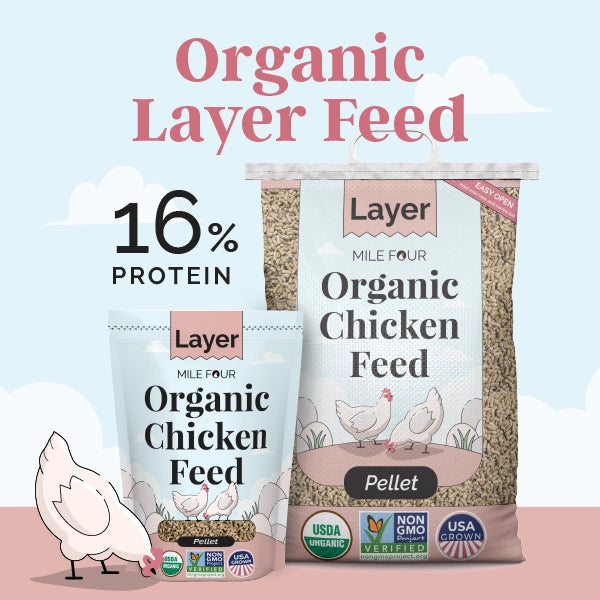
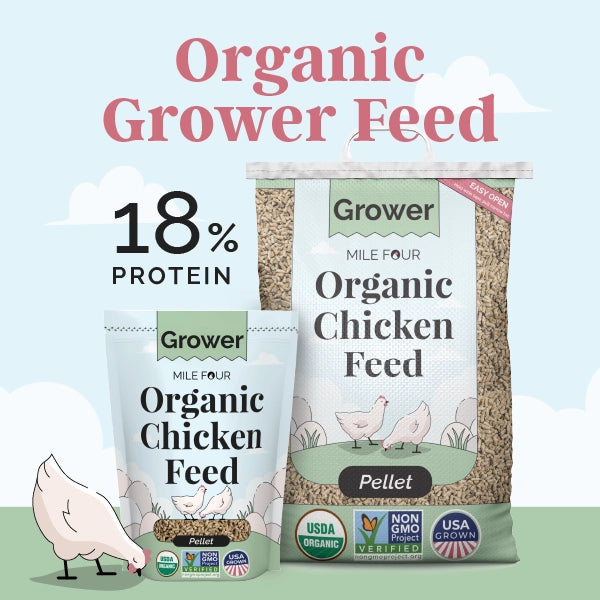
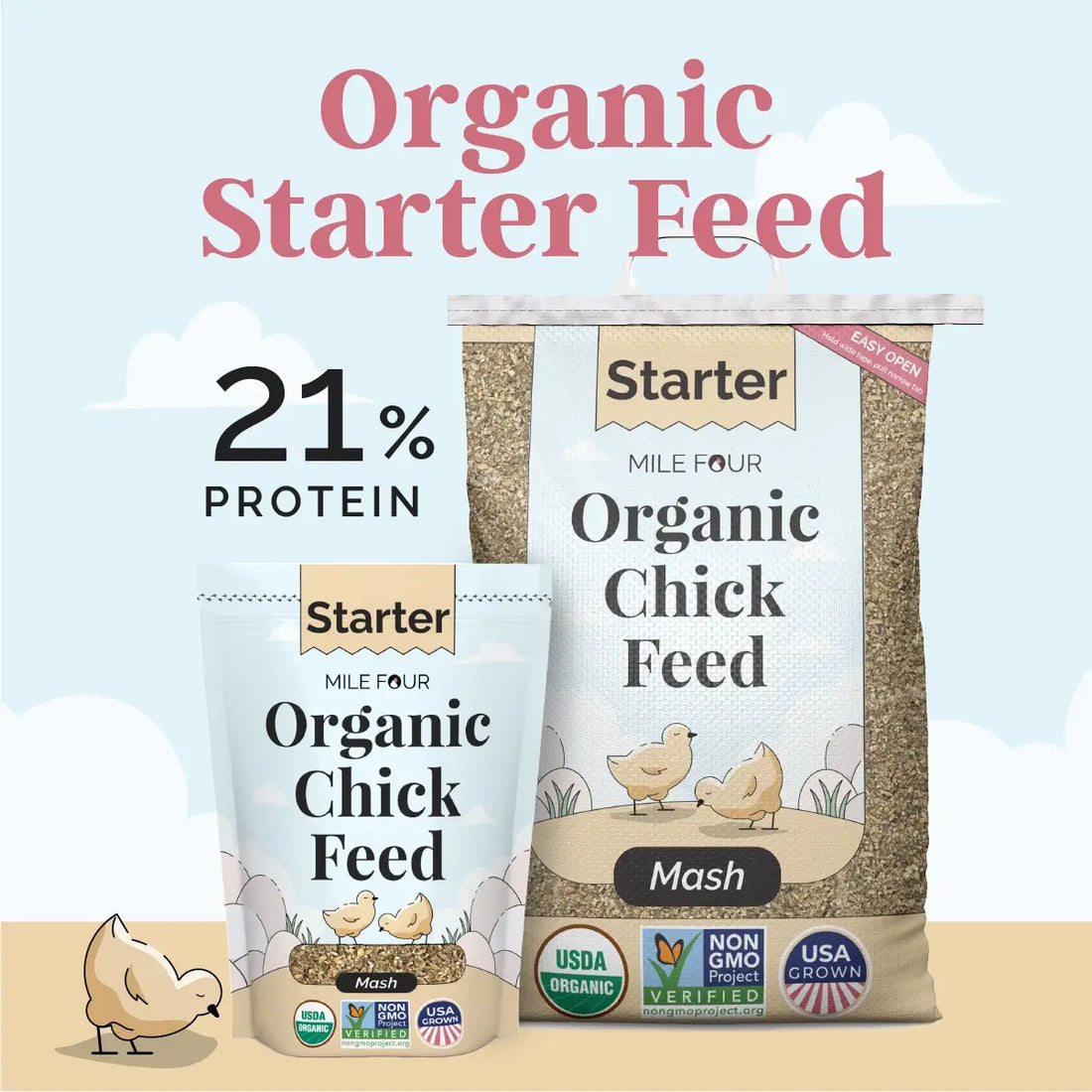
Feed milled fresh from USA-grown grains, free of corn & soy, with every ingredient traceable to its source is a different product than a bag that technically qualifies for the seal & not much else. Mile Four's Organic Chicken Feeds are USDA-certified, corn & soy-free, & milled fresh. If knowing what's actually in the bag matters, that's where the difference is.
New to Mile Four? Organic Feeds milled fresh from USA-grown grains, no corn, no soy, no synthetic additives. Shop Organic Feed →
Sources
- USDA AMS, National Organic Program — 7 CFR § 205.237, organic livestock feed regulations & 3-year land transition requirement (ams.usda.gov)
- USDA AMS, Guidelines for Organic Certification of Poultry, developed with NOFA-VT (ams.usda.gov)
- USDA AMS, Allowed and Prohibited Substances — National List of permitted & prohibited inputs in organic production (ams.usda.gov)
- Rodale Institute, "Organic Certification" — 3-year prohibition on prohibited substances before certified harvest (rodaleinstitute.org)
- Foldager et al. (2021), "Impact of feed glyphosate residues on broiler breeder egg production and egg hatchability," Scientific Reports — glyphosate detected in conventional eggs; negative association with hatchability (nature.com)
- Akinola et al. (2024), "Mycotoxin contamination and the nutritional content of corn targeted for animal feed," Poultry Science — 100% of 328 southeastern U.S. corn samples contaminated with fumonisin (pmc.ncbi.nlm.nih.gov/articles/PMC11426393)
- Rios et al. (2026), "Mycotoxin occurrence in poultry feed and feed ingredients in the southeastern U.S.," Poultry Science — 86% of 572 poultry feed samples positive for fumonisin, 45% for deoxynivalenol (sciencedirect.com)
- Kerekhazi et al. (2024), "Hidden Hazards Revealed: Mycotoxins and Their Masked Forms in Poultry," PMC — sublethal effects on feed efficiency, growth, & immune function (pmc.ncbi.nlm.nih.gov)
- poultry.extension.org, "Drugs Approved for Use in Conventional Poultry Production" — coccidiostats permitted in conventional feed, prohibited in organic
- ChickenCheck.In / National Chicken Council — more than 80% of U.S. corn & soybeans grown from GMO seed (chickencheck.in)
This content is for educational purposes only and is not a substitute for professional veterinary advice. Consult a licensed veterinarian for health concerns specific to your flock.