

Layer feed already has calcium in it. The bag says so. So why does everyone keep saying to add oyster shell on top of that?
The answer has more to do with timing than quantity. Once that clicks, the whole thing makes sense.

What Oyster Shell Actually Does
An eggshell is about 94% calcium carbonate. Each one takes roughly 20 hours to form, & most of that work happens overnight when the hen isn't eating.
During those overnight hours, the hen's body is pulling calcium from two places: whatever is still moving through her digestive system, & her bones. The bones have a calcium reserve called medullary bone, a porous reactive bone tissue that forms specifically in laying hens as their bodies prepare for egg production. It builds up before laying starts, & gets drawn on every night to supply the shell gland.
When dietary calcium runs short, the bones compensate. That works in the short term. Over time, if the bones are being tapped more than they're being replenished, the hen's skeletal structure weakens. Research published in Poultry Science & multiple peer-reviewed journals has documented progressive bone loss in hens with chronic low calcium intake, eventually leading to fractures & reduced laying ability.
Oyster shell's job is to reduce how much the bones have to do. Coarse particles dissolve slowly in the gizzard, releasing calcium steadily through the night rather than all at once. That slow release is why coarse oyster shell outperforms finely ground calcium sources for overnight eggshell formation.
So Why Isn't Layer Feed Enough on Its Own?
Layer feed is formulated to meet calcium requirements under normal conditions. Mile Four Layer feed contains 3.10–4.50% calcium. That is enough to support consistent shell quality when the flock is eating well & nothing else is pulling their intake down.
The problem is that real flocks don't always eat under normal conditions.
High-producing hens lay close to an egg per day. In summer heat, feed intake drops. Older hens lay larger eggs, which require the same amount of calcium spread over a bigger surface. Flocks with access to pasture, treats, or fermented feed may eat less of their base ration on any given day. Any of these scenarios can create a calcium gap even when the feed is formulated correctly.
Oregon State University Extension is direct about it: some high-producing hens may need supplemental oyster shell even when eating a complete layer diet. Shell quality is the indicator. Thin shells, rough texture, or shells that crack too easily signal that what's in the feed isn't meeting the demand.
Free-choice oyster shell lets hens self-regulate. The ones that need more take more. The ones that don't, leave it alone. Overthinking this one is the actual problem.
When to Start (& Why Earlier Is the Wrong Answer)
Start offering oyster shell when pullets are 18–20 weeks old, or at the point of lay, whichever comes first. Not before.
Young birds' kidneys cannot process high calcium loads. Excess calcium before laying begins has been documented in peer-reviewed research to cause kidney lesions, urolithiasis (mineral deposits in the urinary tract), & in severe cases kidney failure. The damage can be cumulative & silent, showing up later as reduced laying performance or shortened lifespan rather than an obvious immediate reaction.
The same applies to roosters. If there's a rooster in the flock, he should never be eating from a forced calcium source. Free-choice oyster shell in a separate dish is safer than calcium mixed into the feed, because he can avoid it. A mixed flock on Layer feed already takes on some calcium risk for the rooster. That is one reason some keepers use a lower-calcium Grower feed for mixed flocks & offer oyster shell free-choice to the hens separately.
The 18–20 week window is when medullary bone starts forming, two to three weeks before the first egg appears. Offering oyster shell at that point means the hen has access to supplemental calcium right as her body starts needing it, rather than playing catch-up after the first thin-shelled egg arrives.
What Happens When Hens Don't Get Enough
The consequences of chronic low calcium don't usually show up all at once. They compound.
The first sign is usually shell quality. Thin shells, soft-shelled eggs, or shells with a sandpapery surface texture are the body's way of signaling that the supply isn't meeting the demand. The hen is still forming eggs. She doesn't have enough calcium to do it properly.
If that continues, the body escalates. Calcium gets pulled from structural bone (not the medullary reserve) to keep shell production going. This leads to weakening of the skeleton, increased fracture risk, & a condition called cage layer fatigue, which affects confined birds most severely but can develop in any hen with sustained calcium deficiency.
University of Florida IFAS puts the calcium math in perspective: a hen laying 250 eggs per year cycles through roughly 20 times the total calcium in her bones over that same period. Every bit of that calcium has to come from somewhere. If dietary sources are consistently short, the bones pay the difference.

How to Offer It
Free-choice, in a separate container from the feed. That's the standard recommendation from every extension service that covers it, & for good reason.
Mixing oyster shell directly into the feed removes the hen's ability to regulate her intake. Some hens need more. Some need less. Younger pullets starting to lay have different requirements than a two-year-old hen in peak production. Mixing it in forces everyone to eat the same amount regardless of what their body is asking for.
A small ceramic or metal dish works fine. Place it near the feeder so it's convenient but distinct. Refill weekly. Keep it dry. Clumped, wet oyster shell loses surface area & doesn't dissolve as efficiently in the gizzard.
One container is enough for most backyard flocks. If the flock is large or there are dominant birds guarding the dish, add a second container on the opposite side of the coop.
The Quick-Reference Summary
| Question | Answer |
|---|---|
| When to start offering oyster shell | 18–20 weeks, or at point of lay. Not before. |
| Do hens on Layer feed still need it? | Often yes, especially high-producers. Free-choice lets them decide. |
| Can chicks or young pullets have it? | No. Excess calcium before laying causes kidney damage. |
| Should roosters eat oyster shell? | No. Free-choice offering (not mixed in feed) lets them avoid it. |
| Can oyster shell replace insoluble grit? | No. Different functions entirely. Oyster shell is calcium. Grit is digestion. |
| Signs of low calcium in the flock | Thin shells, soft shells, rough texture, increased breakage. |
| How to offer it | Separate dish, near feeder, free-choice, refilled weekly, kept dry. |
If shells are already coming out strong & the flock is eating consistently, the current setup is working. If shells are thinning, cracking more than usual, or showing surface texture changes, free-choice oyster shell is the first thing worth adding before looking further.
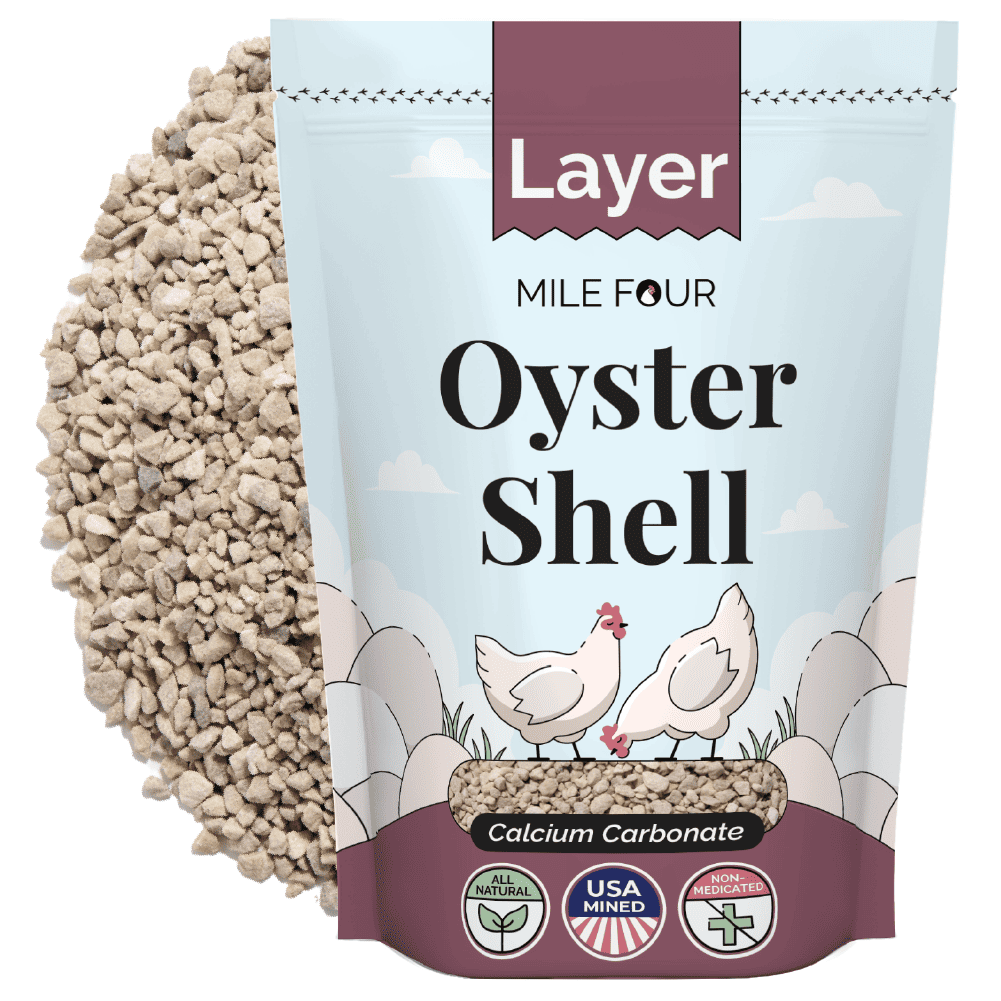
Mile Four Oyster Shell is coarse-ground for slow overnight calcium release. That particle size matters most for shell quality. For flocks also eating whole grain, insoluble grit belongs in a separate dish alongside it.
New to Mile Four? The Organic Feeds are milled fresh from USA-grown grains, with no corn, soy, or fillers.
Sources:
• Hy-Line Brown Laying Hens Study (2013). Effects of dietary energy and calcium levels on performance, egg shell quality and bone metabolism in hens. Poultry Science. doi:10.1016/j.psj.2013.07.012 (peer-reviewed study confirming low dietary calcium is associated with poorer eggshell quality & bone health in laying hens);
• Shane, S.M., Young, R.J., Krook, L. (1969). Renal and parathyroid changes produced by high calcium intake in growing pullets. PubMed PMID: 5812090 (foundational peer-reviewed study on kidney lesions caused by excess calcium in immature pullets);
• Torrentó, M. et al. (2021). Relationship between Bone Quality, Egg Production and Eggshell Quality in Laying Hens at the End of an Extended Production Cycle. PMC7996911. (documents progressive bone calcium depletion and medullary bone function across extended laying cycles);
• Jacob, J. & Mather, F. (2000). Concepts of Eggshell Quality. University of Florida IFAS Extension VM013. ask.ifas.ufl.edu (calculates calcium demand during the 20-hour eggshell formation process; documents that a hen cycles through ~20x her bone calcium annually via egg production);
• Hermes, J.C. (2025). How to Feed Your Laying Hens. Oregon State University Extension PNW-477. extension.oregonstate.edu (recommends free-choice oyster shell for high-producing hens on complete layer feed; advises examining shell quality as the primary indicator);
• The Poultry Site. Avian Urolithiasis (Visceral Gout): An Overview. thepoultrysite.com (documents kidney damage pathway from excess dietary calcium in immature pullets including gout & calcium deposits in the ureter).
This content is for educational purposes only and is not a substitute for advice from a licensed poultry veterinarian. If a hen is showing signs of shell quality problems, mobility issues, or other health concerns, consult a veterinarian experienced with poultry.