
Mealworms are everywhere. Every feed store carries them. Every chicken keeper has tried them.
They're fine. Chickens love them. But if you've ever looked at the calcium content on a bag of dried mealworms, it's not great. It's actually kind of embarrassing for an insect.
BSFL are a different story.
Black soldier fly larvae. Short version: BSFL. They look like small, fat, pale grubs. Chickens treat them like currency. What makes them worth talking about isn't the reaction they get from the flock, though. It's what's packed inside them.
High protein. Meaningful calcium. A fat profile that helps other nutrients absorb. Chitin in the shell that feeds the gut bacteria doing quiet work in the background.
Think of mealworms as a protein snack. BSFL are more like a multivitamin that chickens will sprint across the yard for.

What Are Black Soldier Fly Larvae?
Hermetia illucens is the scientific name. The larvae are the pre-pupal stage of the black soldier fly, harvested before they become adults, then dried for shelf stability.
They're not a new concept in poultry nutrition. Commercial producers have used insect meal for years. What's newer is the availability of dried BSFL as a backyard supplement. Small bags, easy to scatter, no special setup required.
One thing to get clear from the start: they're a treat, not a complete feed. That distinction matters, and it'll come up again.
The Nutrition Case
Dried BSFL typically contain around 40 to 45% crude protein. That's well above most complete feeds, which sit somewhere in the 16 to 21% range depending on life stage. The protein is also dense in lysine and methionine, two amino acids that do real work in feather development and tissue repair.
The fat content runs around 28 to 35%. Think of it like the difference between a handful of mixed nuts and a piece of bread. More energy per bite.
But the number that stands out most is calcium.
Dried BSFL contain roughly 3% calcium, and they carry it in a ratio with phosphorus (approximately 1.5:1) that makes it actually usable. For laying hens, this matters. A hen pulls significant calcium out of her diet every single day just to form one eggshell. When her diet comes up short, her body starts borrowing from her bones instead.
BSFL deliver calcium in a form her body can actually put to work.

How BSFL Compare to Mealworms
Mealworms are the more familiar treat. Chickens love them. But the nutritional comparison is lopsided once you look at calcium specifically.
| Dried BSFL | Dried Mealworms | |
|---|---|---|
| Crude Protein | ~40 to 45% | ~50 to 55% |
| Fat | ~28 to 35% | ~20 to 30% |
| Calcium | ~3% | ~0.05 to 0.1% |
| Ca:P Ratio | ~1.5:1 (favorable) | ~0.05:1 (inverted) |
Mealworms have a slight edge in raw protein percentage. Everything else tilts toward BSFL, especially for layers. The calcium-to-phosphorus ratio in mealworms is so inverted that some commercial mealworm products add calcium dust after drying just to compensate.
Neither one replaces a complete feed. But if the choice is between the two as a supplement, BSFL bring significantly more to the table.
What Chickens Actually Use BSFL For
Molt support. Feathers are roughly 90% protein. When a hen drops her coat in fall, her protein needs spike sharply. A high-protein supplement during that window gives her body more raw material to work with. BSFL fit that role well.
Eggshell quality. The calcium content and its favorable ratio with phosphorus makes BSFL a useful secondary calcium source, especially for hens who don't self-regulate well on free-choice oyster shell. It won't replace a dedicated calcium supplement for heavy layers, but it contributes meaningfully.
Gut health. BSFL contain chitin, the structural material of their exoskeleton. Chickens can't digest chitin directly, but it acts as a prebiotic fiber. It's a bit like how humans can't digest celery, but celery still does something useful on the way through. Research published in Poultry Science suggests chitin supports beneficial gut bacteria, and the antimicrobial peptides in BSFL may offer some immune-modulating properties as well.
Enrichment. This one gets undersold. Scatter dried BSFL in the run and you get several minutes of engaged, purposeful foraging. That's not a small thing, especially in winter when outdoor access shrinks.

Live vs. Dried
Both work. Live larvae trigger foraging instinct harder because they move. The downside is they need to be used quickly and stored carefully.
Most backyard keepers work with dried BSFL. They store longer, are easier to measure out, and the nutritional profile is close enough that the difference rarely matters at the scale of a backyard flock.
Dried BSFL also mix into feed without much fuss. If fermenting, add them toward the end so they don't disappear into the slurry before the birds get to them.
How Much to Offer
BSFL are a supplement, not a staple. Treats of any kind, including BSFL, should stay at or below 10% of total daily feed intake. For most backyard flocks, that means a small handful scattered once a day.
Too much of any high-protein supplement can push the overall diet out of balance. There's no benefit to going past what the flock can actually use.
Introduce them gradually, especially if the birds have never had them before. A tablespoon per bird is a reasonable starting point.
A Note on Sourcing
Not all BSFL products are the same. The larvae's nutritional content varies depending on what they were fed during development. Larvae raised on food-grade substrates tend to have more consistent protein and calcium profiles than those raised on lower-quality waste streams.
Look for products that specify the substrate and are processed without preservatives or additives. The market has grown fast and quality varies, so the label is worth reading before committing.
The Short Version
BSFL are one of the more legitimately useful treats available for backyard flocks. The protein is high-quality. The calcium is bioavailable. The chitin supports gut health in ways mealworms don't even come close to.
For molting hens or layers who need extra calcium support, they're a practical addition. For the rest of the flock, they're a solid protein boost that doubles as enrichment.
They're not magic. They're not a feed replacement. But as far as supplements go, the research behind them is solid.
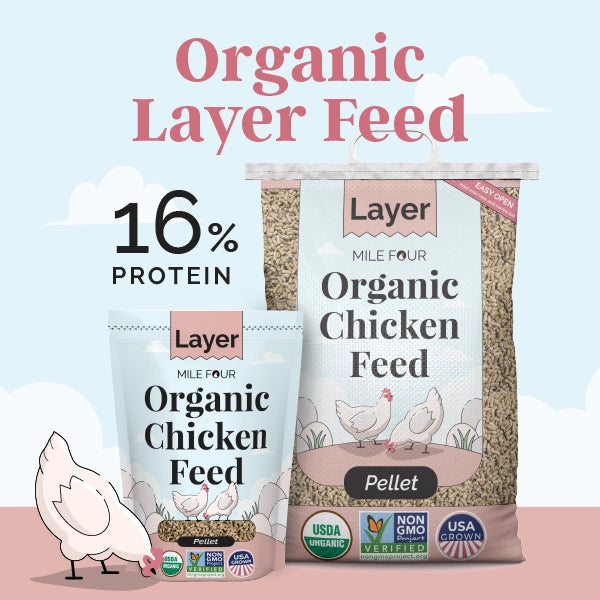
Good feed still comes first. BSFL work best on top of a complete, balanced ration. Organic Layer Feed gives laying hens the protein, calcium, & mineral foundation they need from week 20 onward. New to Mile Four? Organic Feeds are milled fresh from USA-grown grains , see the full collection here.
Sources
- Schiavone, A. et al. (2017). Nutritional value of the black soldier fly (Hermetia illucens) & its suitability as animal feed: a review. Journal of Insects as Food and Feed, 3(2), 105–120. Protein, fat, & mineral analysis of dried BSFL.
- Bellezza Oddon, S. et al. (2021). Black soldier fly & yellow mealworm live larvae for broiler chickens: effects on bird performance & health status. Journal of Animal Physiology & Animal Nutrition, 105(1), 10–18. Chitin & immune function in broilers.
- PMC / Ghent University (2021). Feeding live BSFL to laying hens: effects on feed consumption, hen health, behavior, & egg quality. Poultry Science, 100(10). Laying hen dosing study, 0–20% inclusion rates.
- PMC (2024). Live black soldier fly larvae in feed for laying hens: effects on gut microbiota & behavior. Poultry Science. Prebiotic & gut microbiome effects of chitin.
- PMC (2024). Effects of feeding unprocessed whole BSFL on performance, egg quality, microbiome & metabolome of quails. Antimicrobial peptide & immune-modulating properties of BSFL.
- UC Cooperative Extension / UC Davis (Pitesky, M.). Black soldier fly larvae chicken feed supplement study. Research on BSFL in laying hen diets at 5–20% inclusion. ucanr.edu.
- Nguyen, T.T.X. et al. (2015). Black soldier fly larvae for food & feed: from nutrients to applications. Calcium-to-phosphorus ratio & bioavailability review.
This post is for educational purposes only. Consult a licensed veterinarian or poultry nutrition specialist for health concerns specific to your flock.