
Few things make a flock move faster than the sound of scratch grains hitting the ground.
One shake of the scoop & suddenly every chicken within earshot has somewhere very important to be.
That enthusiasm can make scratch feel like an essential part of feeding chickens. It is not. Scratch is a treat that gives chickens something enjoyable to hunt for, but it does not provide the balanced nutrition they need as their main feed.
The practical rule is simple: keep a complete, life-stage-appropriate chicken feed at the center of the diet & limit scratch, along with all other treats, to no more than about 10% of what the flock eats.
That still leaves a few questions. What is actually in chicken scratch? How do you measure 10% without following every hen around with a kitchen scale? And what happens when a casual handful becomes several casual handfuls?
Let’s clear it up.
What Is Chicken Scratch?
Chicken scratch, also called scratch grain or scratch feed, is a loose mixture of grains intended to be scattered for chickens to find.
Depending on the product, it may contain cracked, rolled or whole grains such as wheat, oats, barley, milo, millet or corn. Some blends include sunflower seeds, peas or other ingredients. There is no single recipe that makes a mixture “scratch,” so the contents & nutritional values can vary considerably between bags.
The name describes how it is commonly offered. Scatter it across the ground or through clean bedding & the flock scratches, pecks & searches for the individual pieces.
That makes scratch useful for encouraging natural foraging behavior. It can keep chickens occupied, draw them into a particular area or help you convince a flock that returning to the run was their idea all along.
Nutritionally, though, a mix of grains is still a mix of grains.
Is Chicken Scratch the Same as Chicken Feed?
No. Scratch grains & complete chicken feed are not interchangeable.
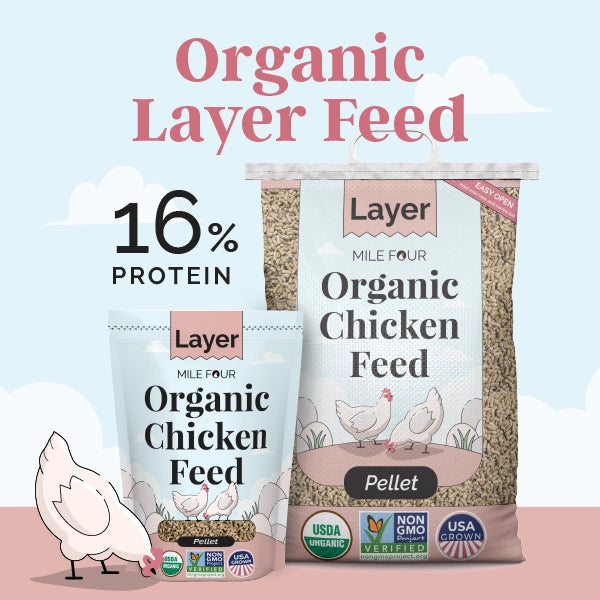
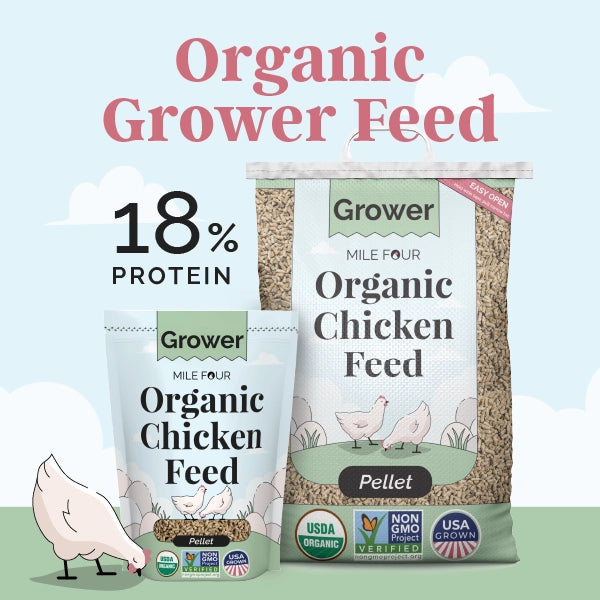
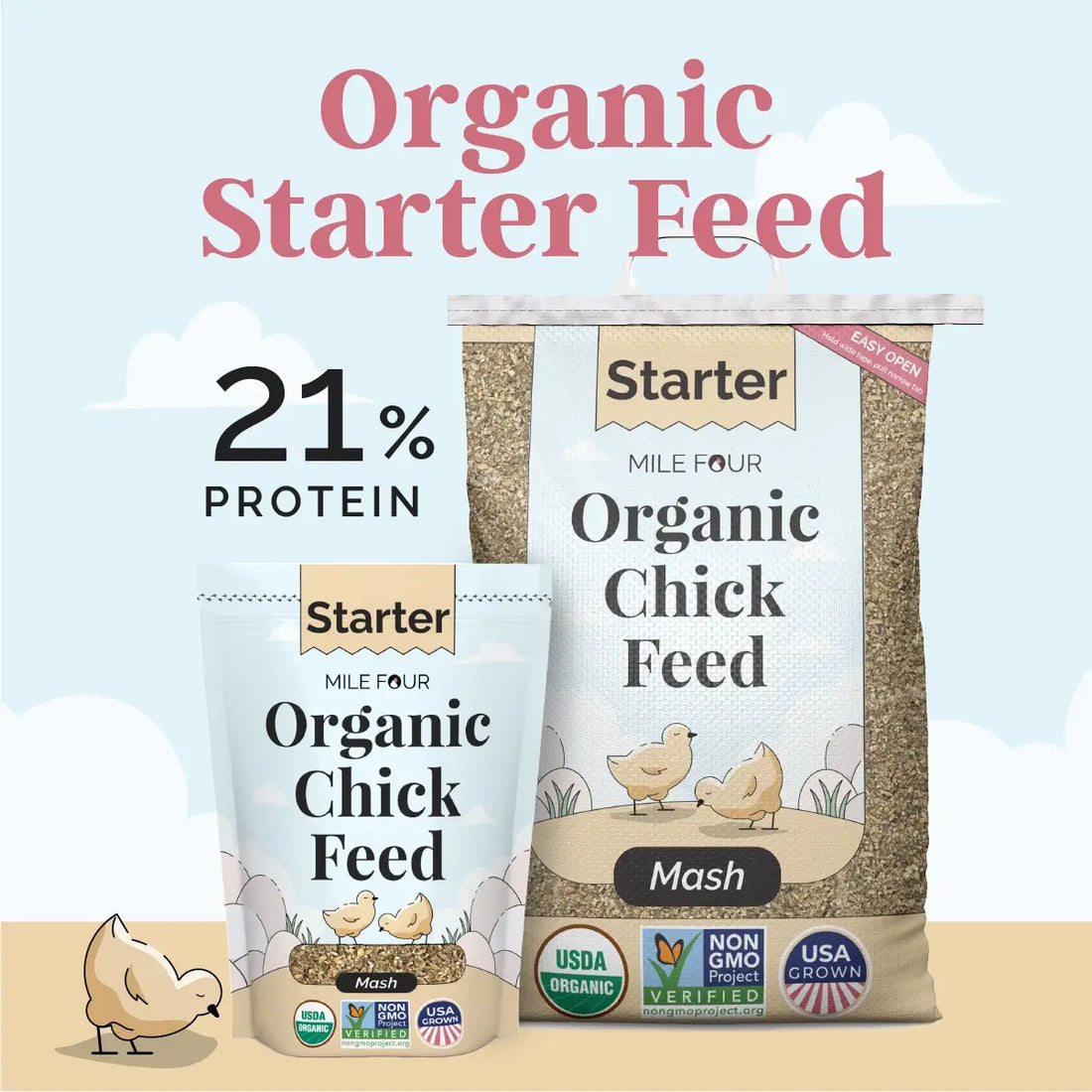
A complete feed is formulated to supply protein, energy, amino acids, vitamins & minerals in proportions appropriate for a particular type & age of chicken. Starter, Grower & Layer Feeds have different formulas because a newly hatched chick, a developing pullet & a laying hen do not have identical nutritional needs.
For a closer look at when each formula belongs in the feeding schedule, follow Mile Four’s 21-Week Chicken Feed Plan.
Scratch is not formulated to do that job.
Individual grains can provide calories & some nutrients, but scratch generally contains less protein & fewer essential vitamins and minerals than a complete feed. It also lacks the carefully calculated balance chickens rely on for growth, maintenance & egg production.
The University of Georgia Cooperative Extension puts the distinction plainly: scratch grains are high in calories but provide much lower levels of key nutrients than formulated poultry feeds.
Chicken Scratch vs. Complete Feed
| Comparison | Chicken Scratch | Complete Chicken Feed |
|---|---|---|
| What it is | A loose mixture of grains | A nutritionally balanced ration |
| Main purpose | Treat, enrichment & foraging | Daily nutrition |
| Nutritionally complete | No | Yes, when formulated for the bird’s life stage |
| How it should be offered | In limited amounts | As the primary food |
| Can it remain available all day? | No | Generally yes, following label directions |
| Can it replace Starter, Grower or Layer Feed? | No | Complete feed should be matched to the bird’s life stage |
Exact ingredients & feeding directions vary by product. Check the label rather than assuming every bag sold as scratch has the same composition.
Why Do Chickens Like Scratch So Much?
For roughly the same reason a person may be more excited by a bowl of chips than a carefully balanced dinner.
Scratch contains energy-rich grains, offers variety & gives chickens the satisfaction of searching for individual pieces. The act of scattering it also turns eating into an activity.
None of that makes scratch bad. It only means enthusiasm is not a nutritional review.
A hen running across the yard at full speed can tell you that she wants the treat. She cannot tell you whether it contains enough protein, calcium, amino acids or vitamins to support her daily needs.
Why Is Scratch a Treat Rather Than a Feed?
A complete feed works because its nutrients are balanced in relation to one another.
When chickens fill up on scratch, they may eat less of that complete ration. The scratch does not simply sit beside the balanced diet. It begins replacing part of it.
This is often described as nutritional dilution.
Imagine a Layer Feed formulated to provide the protein, calcium, vitamins & minerals a laying hen needs when eaten as directed. If a meaningful share of her daily food is replaced with lower-protein grains, the overall diet she consumes no longer has the same nutritional profile as the feed in the bag.
That matters because chickens do not save the balanced portion for later out of respect for the nutrition label. They may pick out the foods they find most appealing first.
Over time, too many extras can contribute to an unbalanced diet, unwanted weight gain & poorer production. The concern is not one generous scoop on one afternoon. It is the daily habit of allowing treats to crowd complete feed off the menu.
If the percentages and ingredient lists on different products are making the decision harder, learn how to read a chicken feed label.
How Much Chicken Scratch Is Too Much?
A widely used guideline is to keep scratch & other supplemental foods to approximately 10% or less of a chicken’s total daily intake.
That is a ceiling, not a required serving.
If your chickens do not receive scratch, nothing is missing from a complete feeding program. If you choose to offer it, small portions preserve its role as a treat without allowing it to displace much of the flock’s regular feed.
University of Maryland Extension recommends that scratch account for about 10% of total daily food consumption. Small and Backyard Poultry offers another practical method: provide scratch in the afternoon, after chickens have eaten their complete feed, and limit it to what they can finish in approximately 15 to 20 minutes.
Both approaches point to the same idea. Complete feed comes first. Scratch stays limited.
What Does the 10% Rule Look Like in Practice?
An adult laying hen commonly eats around ¼ pound, or 4 ounces, of complete feed per day, although actual intake changes with the bird’s size, breed, activity, weather & the energy content of the ration.
Using 4 ounces as a simple estimate, 10% would equal no more than about 0.4 ounce of scratch per hen per day.
| Flock Size | Estimated Daily Food Intake | 10% Maximum for All Treats |
|---|---|---|
| 4 hens | 16 oz | 1.6 oz |
| 6 hens | 24 oz | 2.4 oz |
| 10 hens | 40 oz | 4 oz |
| 20 hens | 80 oz | 8 oz |
These figures are rough upper limits based on an estimated 4 ounces of food per hen. They are not prescribed daily servings.
More importantly, the treat allowance is shared.
If the flock also receives grubs, mealworms, fruit, vegetables or table scraps that day, those foods count toward the same 10%. It is not 10% scratch plus 10% grubs plus whatever disappeared while you were cleaning out the refrigerator.
If grubs or mealworms are also part of the rotation, read the comparison of black soldier fly larvae vs. mealworms for chickens.
For the clearest measurement, weigh the portion occasionally. “One handful” can change considerably depending on whose hand is holding it & how popular they are hoping to become with the chickens.
The Easier Method: Feed by Timing
Most backyard keepers do not want to calculate the daily grain allowance every time they step into the coop.
Timing offers a simpler safeguard.
Give chickens access to their complete feed first & offer scratch later in the day. This gives them time to eat the food that supplies their primary nutrition before the more exciting option appears.
Scatter only a small amount & avoid immediately adding more because it disappeared quickly. A flock can finish a treat in seconds & remain completely willing to conduct another round of quality testing.
You can also use the 15-to-20-minute guideline. Offer only what the flock can clean up within that period, while still treating the 10% rule as the better boundary when the two methods would produce different amounts.
Do Chickens Need Scratch Every Day?
No. Chickens do not need scratch grain daily, seasonally or at all when they are already eating a complete feed.
Scratch can be enjoyable enrichment, but it is optional.
You might use a small amount to:
- Encourage scratching & foraging
- Bring chickens back into the run
- Keep the flock occupied while you complete chores
- Distribute birds over a larger area
- Make occasional handling or health checks easier
Those are management & enrichment benefits, not evidence that scratch is nutritionally necessary.
Does Scratch Keep Chickens Warm in Winter?
Scratch is often described as a winter food because digesting grains supposedly keeps chickens warm overnight.
There is a small piece of truth underneath an oversized claim. Chickens need enough dietary energy to maintain body temperature, and feed intake can rise during cold weather. Eating & digestion also produce some heat.
But scratch does not have a special warming property that complete feed lacks.
A properly formulated feed already supplies energy along with the protein, vitamins & minerals the flock needs. Replacing too much of it with scratch during winter may be especially unhelpful because chickens still need balanced nutrition while using additional energy to stay warm.
A modest late-afternoon portion can be offered as a treat. It should not become the flock’s cold-weather nutrition plan.
Fresh water, appropriate shelter, good ventilation & continual access to complete feed matter far more than a bedtime scoop of grain.
Do Chickens Need Grit with Scratch?
Chickens use insoluble grit in the gizzard to grind whole grains, seeds & other fibrous foods.
Birds with regular access to suitable soil may find small stones naturally, but you cannot always tell whether the amount or size available is appropriate. Chickens kept in enclosed runs or on surfaces without usable stones should have appropriately sized poultry grit offered separately.
Commercial poultry grit is the more dependable choice. For more context on when it is needed, read Do Chickens Need Grit?
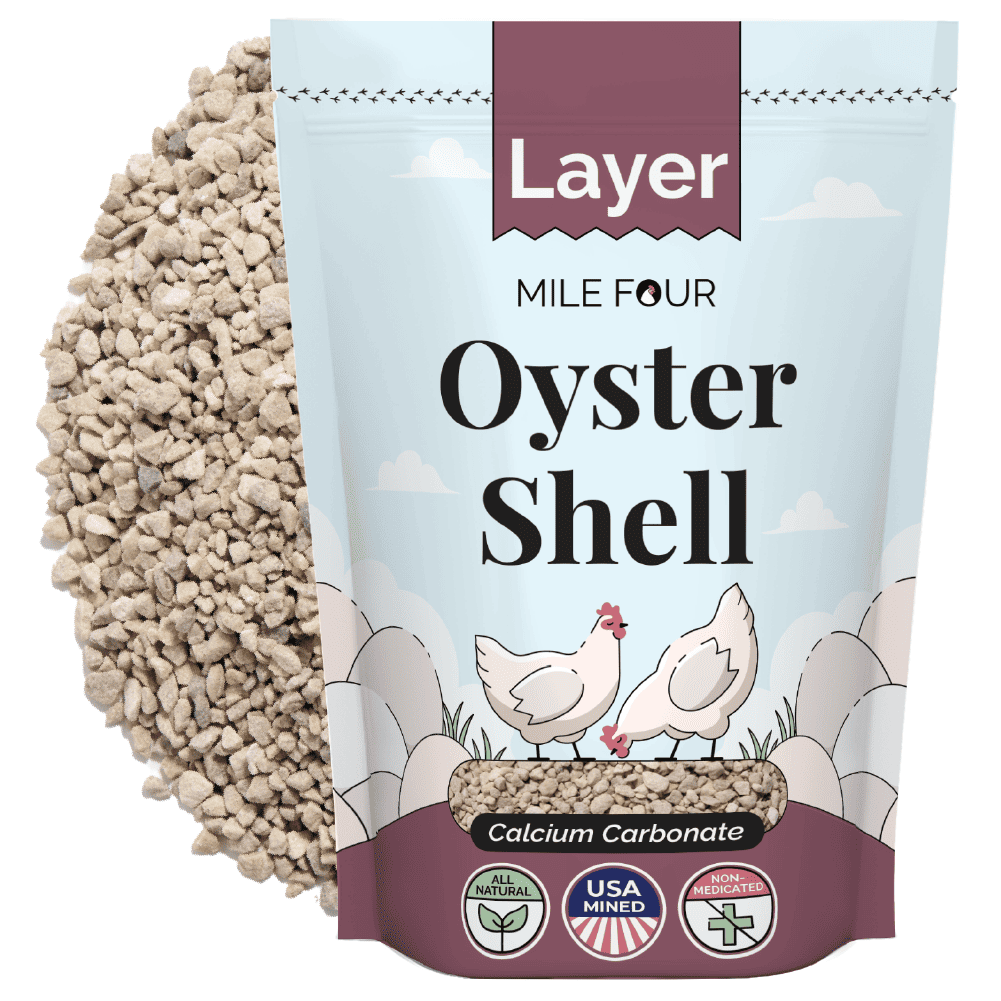
Oyster shell is not a substitute for grit. Oyster shell supplies calcium & is soft enough to break down in the digestive system. Insoluble grit is harder & performs the mechanical grinding job.
Offer each separately so the birds can take what they need.
Can Chicks Eat Scratch Grains?
Young chicks should receive a complete Starter Feed appropriate for their age. That feed needs to remain the clear foundation of their diet during a period of rapid growth.
Many scratch mixtures also contain pieces that are too large for young chicks. If anything other than a complete commercial feed is offered, chicks need access to grit of the correct size, not adult poultry grit.
Because scratch provides little nutritional advantage to a chick & can dilute the Starter Feed supporting early development, there is no need to introduce it simply because the adult flock receives it.
If you do offer treats to older chicks, keep them extremely limited, choose age-appropriate pieces & follow the recommendations for the Starter Feed you use.
Is Scratch Better Scattered or Put in a Feeder?
If the goal is enrichment, scattering a small portion across clean, dry ground or fresh bedding gives the flock something to search for.
Avoid throwing grain into wet litter, mud, manure or areas where it can become moldy or contaminated. Do not scatter more than the birds will collect promptly. Leftover grain can attract rodents & wild birds, which creates sanitation and biosecurity concerns.
A dish or feeder makes the amount easier to monitor, but it removes much of the scratching activity that gives the product its name.
Either approach can work. Portion control & cleanliness matter more than the serving style.
Signs the Flock May Be Getting Too Much Scratch
There is no single behavior that proves scratch has unbalanced the diet, but the feeding routine may need adjusting if:
- Chickens wait for treats instead of eating their regular feed
- Complete feed consumption has noticeably fallen
- Large amounts of scratch are offered several times a day
- Grain remains on the ground after the flock loses interest
- Birds are gaining excess weight
- Egg production or shell quality changes without another clear explanation
- Scratch & other extras together regularly exceed about 10% of daily intake
These signs can have more than one cause. Changes in appetite, weight, laying or health should not automatically be blamed on treats. Review the complete diet & contact a poultry veterinarian when a bird appears ill or production changes persist.
Scratch Is Not the Villain
Scratch grains are not inherently unhealthy. The problem is asking them to do a job they were never formulated to do.
In a small portion, scratch can encourage natural foraging, add variety & make routine flock management easier. In a large portion, it can replace too much of the balanced feed chickens depend on.
Keep complete Starter, Grower or Layer Feed at the center of the flock’s diet. Offer scratch after the birds have eaten their regular feed, count it alongside every other treat & keep all treats below approximately 10% of total daily intake.
The chickens will almost certainly argue for a larger serving.
That is why they are not in charge of the scoop.
Looking for something worth running across the yard for? Explore Mile Four Chicken Scratch, made to be scattered, searched for & enjoyed in moderation.
Sources
- University of Maryland Extension, “Feeding the Flock”: scratch-grain composition, nutritional dilution, the 10% guideline & grit recommendations.
- Small and Backyard Poultry, “Feeding Chickens for Egg Production”: complete-feed guidance, scratch-grain nutrition, afternoon feeding, the 15-to-20-minute limit & grit.
- University of Georgia Cooperative Extension, “Feeding Poultry Right”: why scratch should not be the sole feed & how it differs nutritionally from formulated poultry feed.
- UF/IFAS Extension, “The 5 Most Common Chicken Feeding Mistakes Beginners Make”: complete-feed guidance, limiting treats & providing grit.
This article is for general educational purposes & is not a substitute for professional veterinary advice. Follow the directions on your feed label & consult a poultry veterinarian about health concerns specific to your flock.