
Every backyard chicken group has that one thread. Someone mentions organic feed & by comment forty, three people are repeating something nobody has stopped to check.
Some of it is true. Some of it sounds true because it has been passed around long enough. Here are five common myths about organic chicken feed, what the standards actually say & where the answer is a little more complicated.
1. Myth: “Organic” Is Just a Marketing Word
This one comes up constantly. The thinking goes that any feed company can put “organic” on a bag, so the word does not tell you much.
What actually holds up: USDA Organic is a regulated certification, not a design choice.
Certified organic operations have to follow documented standards covering how agricultural ingredients are grown, handled & processed. The land used to grow organic crops cannot have prohibited substances applied during the three years before harvest. Certified operations are also subject to recordkeeping requirements & inspections.
That does not mean the certification tells you everything about a bag of feed. It does mean the word “organic” carries requirements that a general term such as “natural” does not.
One requires a documented production system. The other can leave quite a few questions unanswered.
2. Myth: Non-GMO Feed Covers the Same Ground as Organic
Non-GMO & organic often appear next to each other on feed labels, which makes them easy to treat as two versions of the same claim.
They are not.
What actually holds up: Non-GMO tells you that genetic engineering was not used. Organic standards cover that too, but they also address how agricultural ingredients are grown, which substances may be used & how certified products are handled.
Organic feed is produced without genetically engineered ingredients, but a non-GMO feed is not automatically organic. It may still contain conventionally grown grains.
For a closer look at what these labels cover, the organic vs. conventional chicken feed guide breaks down the differences without asking you to memorize the side of a feed bag.
3. Myth: Corn-Free & Soy-Free Feed Cannot Provide Complete Nutrition
Corn & soybean meal are common in chicken feed, so leaving both out can sound like leaving out the nutrition along with them.
But familiar ingredients are not the only ingredients capable of doing the job.
Field peas can contribute protein, energy & lysine. Other ingredients can help provide the additional amino acids, energy, vitamins & minerals birds need. The value of any one ingredient depends on how it works with everything else in the formula.
What actually holds up: A corn-free & soy-free feed can provide complete nutrition when the entire formula is properly balanced for the bird’s age & life stage.
The better question is not whether corn or soy appears on the label. It is whether the finished feed supplies the full balance of nutrients the flock needs.
4. Myth: Organic Farms Use Pest Controls Too, So the Standards Are Basically the Same
This argument starts with something true: organic does not mean nothing is ever used to manage weeds, pests or disease.
The part that gets lost is that organic growers operate under a different set of rules.
Organic crop production relies first on practices such as crop rotation, soil management & biological or mechanical controls. When those practices are not enough, certain approved substances may be used. Most synthetic substances are prohibited, while limited exceptions are allowed under specific conditions.
Conventional agriculture can use a broader range of synthetic pesticides, herbicides & fertilizers. Those products are still regulated, but the standards governing their use are not the same as USDA Organic standards.
What actually holds up: Organic-approved pest controls exist. That does not make organic & conventional production interchangeable.
One observational study involving commercial broiler-breeder flocks found a negative association between glyphosate residue in feed & egg hatchability. Researchers also detected traces in some conventional & organic grocery-store egg samples, although the amounts were below the test’s quantification limit.
The study did not prove that glyphosate caused the difference in hatchability, & it was not conducted on backyard laying hens. It does show why questions about agricultural inputs & residues cannot simply be dismissed as something that ends at harvest.
5. Myth: Organic Feed Guarantees Healthier Chickens & Better Eggs
This myth comes from the other side of the argument. If organic feed follows stricter production standards, it must automatically mean more eggs, stronger shells & chickens that never have an off day.
Chickens, unfortunately, are not that predictable.
Egg production can change with age, breed, daylight, weather, molt, stress & overall health. Shell quality can also be influenced by calcium intake, nutrition, age & how well an individual hen absorbs and uses those nutrients.
What actually holds up: Organic certification gives chicken keepers more information about how agricultural ingredients were produced & handled. It does not guarantee a particular egg count, yolk color, shell quality or health result.
The better question is whether a feed provides complete nutrition for the flock’s life stage, uses ingredients that fit your priorities & comes from a company willing to explain what is inside the bag.
What the USDA Organic Seal Does Not Tell You
Organic certification can tell you a great deal about how agricultural ingredients were grown & handled. It cannot tell you when a particular bag was milled, how long it spent in storage or where the grains came from.
Those questions still matter. They simply have to be answered by the company behind the feed rather than the seal on the front.
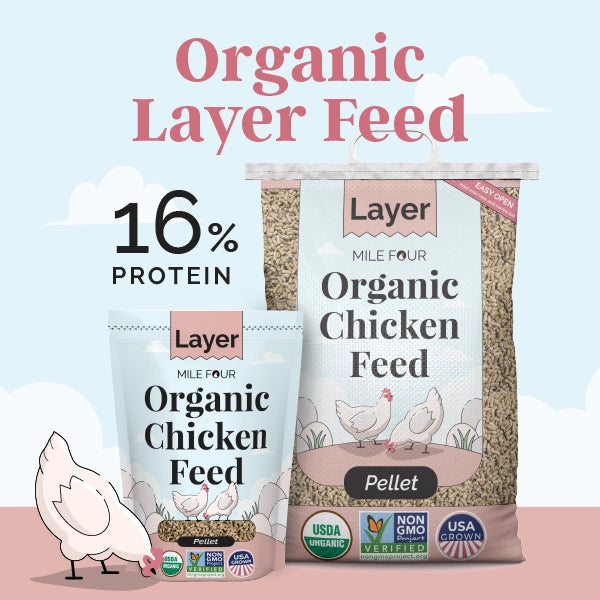
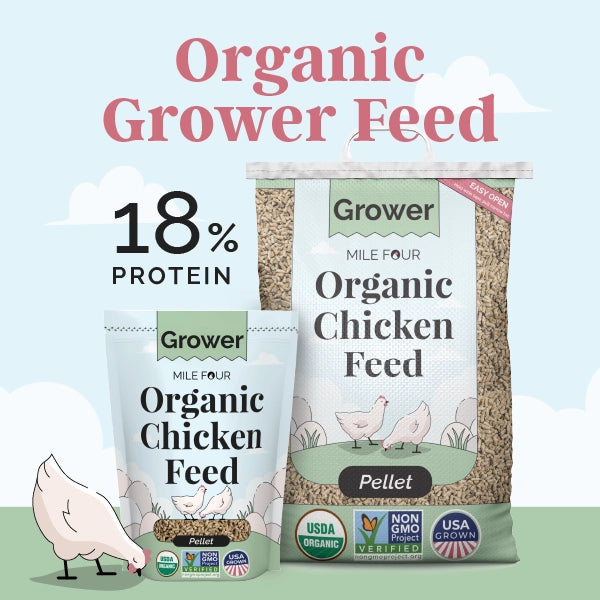
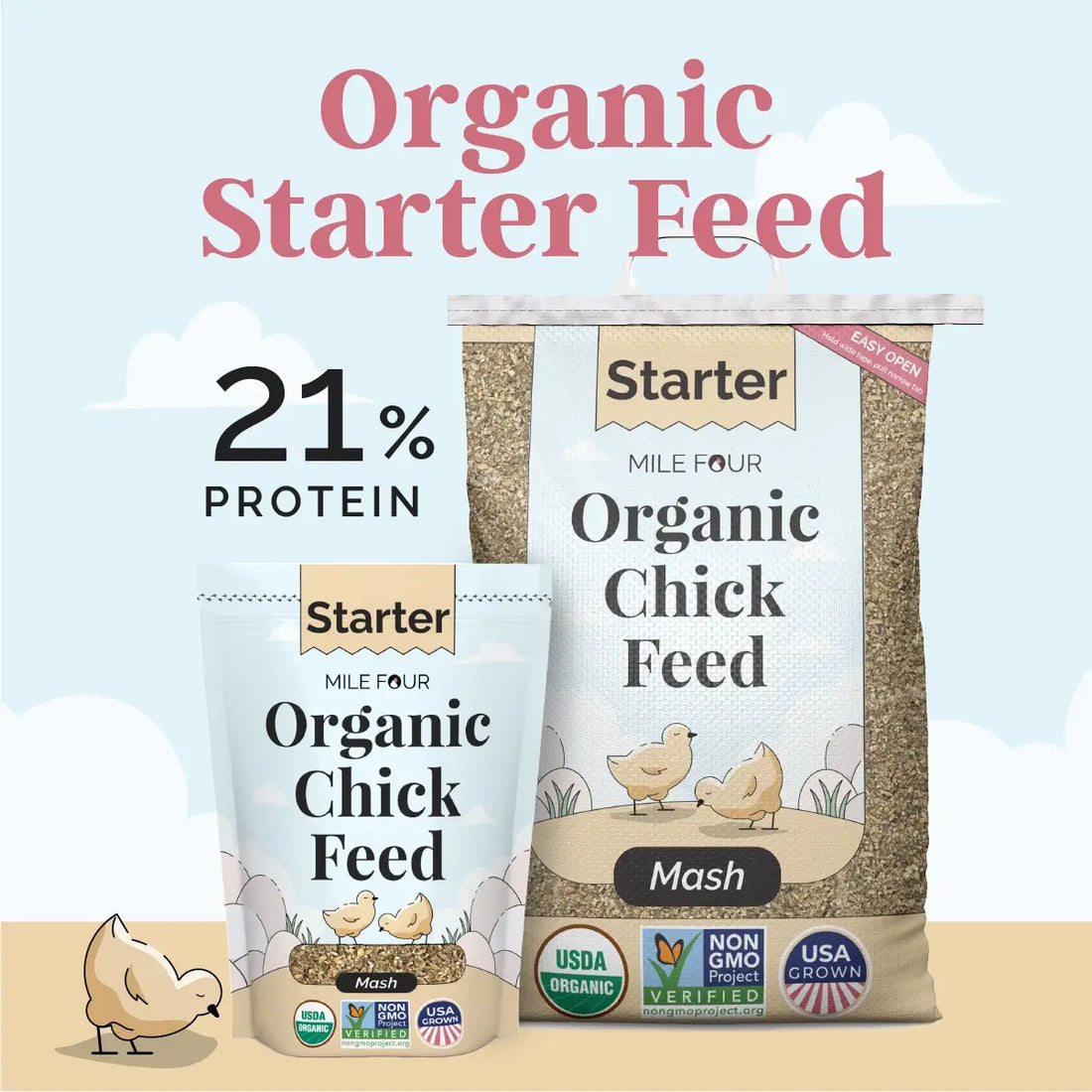
Mile Four Organic Chicken Feeds are USDA Certified Organic, Non-GMO, corn-free & soy-free. They are milled fresh from 100% US-grown grains sourced from family farms.
If those details matter to you, explore the complete range of Starter, Grower & Layer Feeds →
Sources:
- USDA Agricultural Marketing Service, National Organic Program: federal standards governing certified organic production, handling, recordkeeping & inspections.
- USDA Agricultural Marketing Service, The National List: allowed & prohibited substances in organic crop, livestock & handling operations.
- Electronic Code of Federal Regulations, 7 CFR § 205.202: three-year land requirement for organic crop production.
- Electronic Code of Federal Regulations, 7 CFR § 205.237: feed requirements for certified organic livestock.
- Poultry Extension, “Field Peas in Poultry Diets”: nutritional value, amino-acid profile & use of field peas in poultry formulations.
- Foldager et al. (2021), “Impact of Feed Glyphosate Residues on Broiler Breeder Egg Production and Egg Hatchability,” Scientific Reports: observational findings involving feed residues, egg samples & hatchability.
This content is for educational purposes only and is not a substitute for professional veterinary advice. Consult a licensed veterinarian for health concerns specific to your flock.