

Making your own chicken feed sounds simple enough.
Buy a few grains. Add a protein source. Mix everything in a large container. Feel impressively self-sufficient every time you fill the feeder.
Then you start researching recipes.
One calls for wheat, oats and sunflower seeds. Another adds peas, kelp and fish meal. A third includes a vitamin premix measured in quantities that make baking bread look wonderfully uncomplicated.
So, can you make your own chicken feed? And is homemade chicken feed actually cheaper, healthier or better than buying it?
You can make chicken feed at home, but making a nutritionally complete ration is more involved than mixing several wholesome ingredients together. For most backyard keepers, buying a complete feed is the simpler and more dependable option. DIY feed makes the most sense when you have a properly formulated recipe, accurate equipment, reliable ingredient sources and enough birds to use bulk ingredients efficiently.
The important distinction is not homemade versus commercial. It is whether the finished feed provides the nutrition your chickens need consistently, day after day.
Can You Make Your Own Chicken Feed?
Yes, chicken feed can be mixed at home.
The harder part is making sure the final mixture is nutritionally complete and appropriate for the chickens eating it.
Chickens do not simply need a varied collection of grains, seeds and vegetables. They need those ingredients to deliver specific levels of energy, protein, amino acids, fat, vitamins and minerals.
A homemade feed might include ingredients such as:
- Wheat, barley, oats or other grains
- Peas, soybean meal, sunflower meal or another protein source
- Flaxseed, vegetable oil or another source of fat
- Calcium and phosphorus sources
- Salt
- Vitamin, mineral and amino acid supplements
Seeing those ingredients in the bucket does not tell you whether the ration contains the right amount of each nutrient.
That is where many homemade chicken feed recipes fall short. They may offer a list of recognizable foods without showing how the finished recipe was formulated, tested or adjusted for a chicken’s life stage.
A good ingredient list is not the same as a balanced ration
Wheat can provide energy. Peas can contribute protein. Sunflower seeds can add fat and other nutrients.
None of those ingredients is nutritionally complete on its own.
Even a mixture containing all three can be too low in an essential nutrient or unbalanced in a way that is not obvious from looking at it.
Protein percentage is one example. Chickens need protein, but they also need particular amino acids, including lysine and methionine. Two mixtures can have a similar crude protein percentage while supplying different amounts of the individual amino acids chickens require.
Minerals present another balancing act. Calcium and phosphorus both matter, and their appropriate levels change with age and production stage. Adding a scoop of calcium does not automatically fix the rest of the formula.
A complete ration should match the chicken’s age and stage of production.
What Does “Complete Chicken Feed” Mean?
A complete chicken feed is designed to provide the nutrients a particular group of chickens needs when it is fed as the primary diet.
The appropriate formula changes as chickens grow.
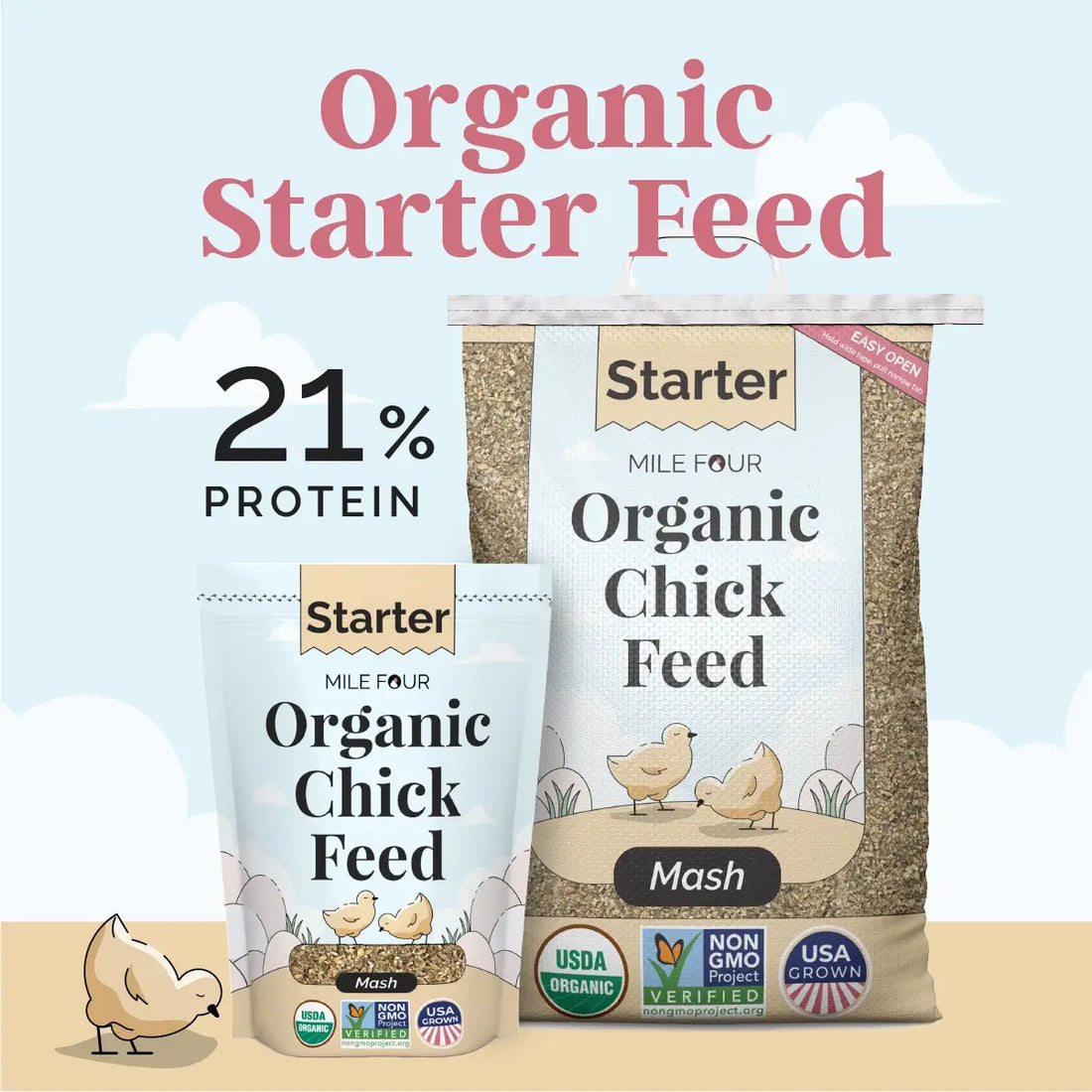
- Starter feed is formulated for young chicks during early growth.
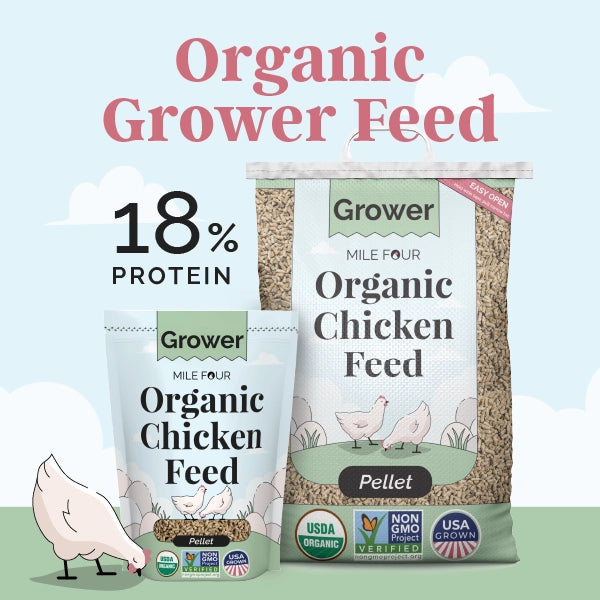
- Grower feed supports developing pullets after the starter stage and before laying.
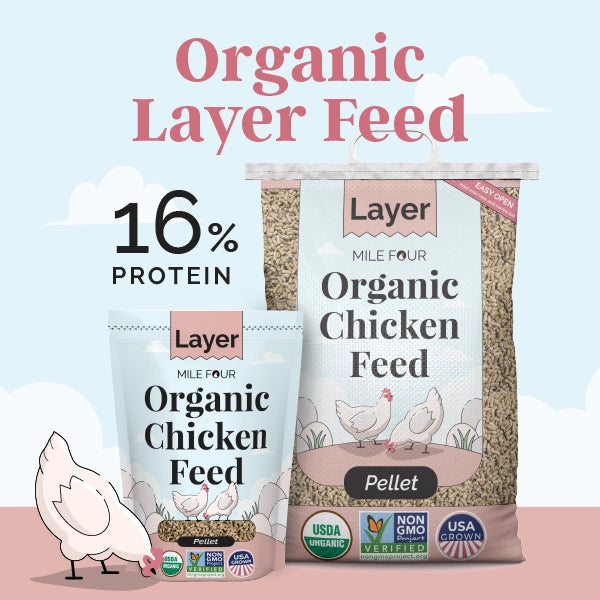
- Layer feed is formulated for mature laying hens and includes nutrition for the demands of egg production.
The ages printed on feed labels can vary somewhat by product and feeding program. Follow the directions provided by the feed manufacturer rather than assuming every starter, grower or layer formula uses the same transition date.
You can see how these stages fit together in our 21-Week Chicken Feed Plan.
Why the smallest ingredients matter
The grains are usually the easiest ingredients to recognize in a feed formula. The smallest additions are easier to overlook, but they can be just as important.
Depending on the recipe, small amounts of premix or other supplements may provide:
- Vitamins
- Trace minerals
- Salt
- Calcium and phosphorus
- Specific amino acids
These ingredients may represent only a small percentage of the finished mixture. That does not make them optional.
It also makes accurate measuring more important. A minor error can have a much larger effect in a small backyard batch than it would in a professionally manufactured batch.
Why Do People Make Their Own Chicken Feed?
People consider DIY feed for several understandable reasons. It is rarely just about wanting another chore.
They want more control over the ingredients
Some keepers want to choose every grain and protein source themselves. They may prefer locally grown ingredients, want to avoid a particular ingredient or simply feel more comfortable seeing everything that goes into the feeder.
Homemade feed offers direct ingredient control. The tradeoff is that the keeper also becomes responsible for the nutritional formulation, sourcing and quality control.
They want to save money
This is one of the strongest reasons people look for homemade chicken feed recipes.
A sack of wheat or oats may cost less per pound than a finished bag of feed. That makes DIY look like an easy win at first glance.
The comparison becomes less clear after adding protein ingredients, vitamin and mineral supplements, shipping, storage equipment and ingredients that may spoil before a small flock can finish them.
They want to be more self-sufficient
Mixing feed can be part of a broader homesteading goal. Someone already growing vegetables, preserving food and raising animals may want more control over another part of the household food system.
That motivation is not always about finding the cheapest option. For some keepers, learning how feed is formulated and sourcing ingredients is part of the hobby.
They have access to homegrown or local ingredients
A keeper with access to locally grown grains may be able to source some ingredients at a favorable price.
Those grains can be useful components of a ration, but their availability does not remove the need to balance the complete formula.
They are concerned about commercial feed
Some keepers are uncomfortable with vague ingredient descriptions or formulas they do not fully understand.
That concern can be addressed in two ways. One is to formulate feed at home. The other is to learn how to read feed labels and choose a complete feed with transparent ingredients and sourcing standards that match your priorities.
Our guide to reading a chicken feed label explains what the guaranteed analysis and ingredient list can tell you before you buy.
Is Homemade Chicken Feed Cheaper?
It can be, but it is not automatically cheaper.
The answer depends heavily on flock size, local ingredient prices, minimum order quantities and how much of each ingredient you can use before it loses freshness.
A small backyard flock and a farm buying ingredients by the pallet are doing very different math.
The grain price is not the finished-feed price
A DIY recipe may appear inexpensive when its largest grain is compared with a bag of complete feed.
But the true cost includes every ingredient required to produce the final ration.
Your calculation may need to include:
- Grains and other energy sources
- Protein ingredients
- Vitamin and mineral premix
- Calcium and phosphorus sources
- Salt and any required amino acid supplements
- Freight or shipping charges
- Minimum purchase quantities
- Storage containers
- A reliable scale and mixing equipment
- Spoilage, pest loss and spilled ingredients
- Your time spent sourcing, weighing, mixing and cleaning
That does not mean homemade feed cannot save money. It means the price of one inexpensive grain is not enough to answer the question.
Small flocks can struggle to capture bulk savings
Many specialty ingredients are less expensive per pound when purchased in large quantities.
That pricing helps only when your flock can use those ingredients while they are still in good condition.
A family with four or six hens may need months to work through several large bags of individual ingredients. During that time, heat, moisture, insects and rodents can turn projected savings into waste.
Buying smaller quantities may solve the storage problem, but it usually raises the cost per pound.
Your time counts, even when you enjoy the work
There is no universal price for an hour spent mixing chicken feed.
For someone who enjoys researching formulas and working with homegrown ingredients, the time may be part of the fun.
For someone already fitting coop cleaning between work, family and everything else, buying complete feed may be worth it simply because it removes another recurring task.
How to calculate your real DIY feed cost
- Calculate the cost of every ingredient used in one complete batch.
- Add shipping, delivery fees and unavoidable minimum-order costs.
- Include the cost of storage containers and mixing equipment.
- Estimate realistic losses from spills, pests, moisture or ingredients you cannot finish.
- Divide the total by the pounds of usable finished feed produced.
- Decide whether you want to assign a cost to the time spent sourcing and mixing.
This calculation tells you the financial cost of the batch. It does not verify whether the formula is nutritionally complete.
For a broader estimate of what your flock may consume, use the Chicken Feed Cost Calculator.
Homemade Chicken Feed vs Store-Bought Feed
Neither route is automatically right for every keeper.
The better choice depends on what you value, what resources you have and how much responsibility you want to take on yourself.
| Consideration | Homemade Feed | Complete Store-Bought Feed |
|---|---|---|
| Ingredient control | You choose and source each ingredient. | You select a finished feed based on its label, formula and sourcing standards. |
| Nutritional responsibility | You are responsible for using and accurately reproducing an appropriate formula. | The manufacturer formulates the feed for the life stage stated on the label. |
| Time required | Requires research, sourcing, weighing, mixing, storage and regular quality checks. | Ready to feed after selecting the correct life-stage formula. |
| Batch consistency | Depends on accurate weighing, thorough mixing and consistent ingredients. | Manufactured to provide a consistent formula when stored and fed as directed. |
| Storage | Several individual ingredients may need separate pest-resistant storage. | Usually requires storage for one finished feed at a time. |
| Potential savings | Possible with favorable bulk sourcing, enough birds and low ingredient waste. | The bag price includes ingredients, formulation, manufacturing and distribution. |
| Best fit | Keepers with an appropriate formula, reliable suppliers, accurate equipment and a practical reason to mix at home. | Most backyard keepers who want convenient, consistent daily nutrition. |
What Can Go Wrong With Homemade Chicken Feed?
The most common problems are not always obvious after one meal.
They are often small formulation or mixing issues repeated over weeks or months.
Using a recipe that was never properly formulated
A recipe can be popular online without being nutritionally complete.
Photos, comments and a long list of natural ingredients do not show whether the finished ration meets the needs of your flock.
Be especially careful with recipes that:
- Do not identify the intended life stage
- Use vague measurements such as scoops or handfuls
- Focus only on crude protein
- Do not address vitamins, minerals or amino acids
- Suggest one formula for chicks, growers and laying hens
- Make health or egg-production promises without supporting evidence
Measuring ingredients by volume
A cup of whole wheat does not weigh the same as a cup of meal, bran or mineral supplement.
Volume measurements become particularly unreliable when a formula contains ingredients with very different densities.
A serious feed formula should use weights. The scale must also be accurate enough for both large ingredients and small supplements.
Not mixing the batch thoroughly
Even a correctly calculated formula can become inconsistent if the ingredients are not distributed evenly.
Small, dense particles can settle. Lightweight ingredients can remain near the top. One scoop may not contain the same proportions as the next.
This matters most when vitamins, minerals and other concentrated ingredients make up only a small part of the batch.
Letting chickens sort out their favorite pieces
Chickens have opinions about dinner.
When a mixture contains visibly different ingredients, some birds may eat their favorite grains first and leave finer or less exciting components behind.
The recipe may be balanced on paper, but the diet each chicken actually consumes may not be.
This risk depends on the formula, feed form, particle size, feeding setup and behavior of the flock. Watch what remains in the feeder rather than assuming everything offered is being eaten proportionally.
Making one formula for every chicken
Young chicks, developing pullets and laying hens do not have identical nutritional needs.
A laying ration generally contains more calcium than a young chick requires. A starter formula is not designed to serve permanently as the sole ration for producing layers.
A mixed-age flock adds another layer of planning because the formula must account for the youngest birds while mature layers may require a separate calcium source.
Read our guide to feeding a mixed-age flock before using one ration for birds at different stages.
Buying more ingredients than the flock can use
DIY savings often depend on bulk purchasing.
Bulk purchasing also creates a storage problem. Instead of protecting one bag of finished feed, you may need to store several grains, meals and supplements separately.
Every container needs protection from moisture, heat, insects and rodents. Ingredients should also be monitored for unusual odors, visible mold, clumping or pest activity.
Never feed ingredients that appear moldy, damp, spoiled or contaminated.
Is Homemade Chicken Feed Healthier?
Homemade feed is not automatically healthier than purchased feed.
Its quality depends on the formula, ingredients, storage, mixing accuracy and what the flock actually consumes.
A thoughtfully designed homemade ration made from sound ingredients can be appropriate. A loosely assembled grain mix can look wholesome while still leaving important nutritional gaps.
The same nuance applies to store-bought feed. Buying a bag does not mean you should stop reading labels.
Look for:
- A complete feed intended for your chickens’ life stage
- A guaranteed analysis you understand
- Clear feeding directions
- An ingredient list and sourcing standards you are comfortable with
- Packaging that is intact and feed that smells and looks normal when opened
“Homemade,” “natural,” “local” and “organic” each describe different qualities. None of those words alone proves that a ration is nutritionally complete.
Can Chickens Live on Mixed Grains?
Mixed grains should not be assumed to be a complete daily ration.
Grains can contribute useful energy and nutrients, but a combination of grains alone may not supply the appropriate balance of protein, amino acids, vitamins and minerals.
Scratch grains are commonly treated as a supplemental food rather than a replacement for complete feed. Feeding large amounts of extras can also dilute the nutrition provided by the main ration.
A good practical rule is to start with a complete life-stage feed, then keep treats and supplemental foods limited enough that they do not displace the balanced ration.
When you are unsure whether a product is complete feed or a supplement, check the label and feeding directions or contact the manufacturer.
Do You Need a Poultry Nutritionist to Make Chicken Feed?
You do not need to hire a nutritionist simply to give your flock the occasional homegrown ingredient or treat.
If you plan to use homemade feed as your flock’s primary diet, make sure the formula has been properly reviewed before relying on it long term.
Professional input becomes especially valuable when:
- The homemade mixture will be the flock’s primary feed
- You are substituting ingredients in an existing formula
- You are feeding chicks or breeding birds
- The flock includes several ages or production stages
- You plan to mix large quantities for long-term use
- Your birds show changes in appetite, growth, body condition, feathers, eggs or behavior
A formula is not a fixed collection of interchangeable ingredients. Replacing one ingredient can change energy, protein quality, fiber, fat and mineral levels throughout the ration.
When Does Making Your Own Chicken Feed Make Sense?
DIY feed can be a reasonable option when several pieces line up.
- You have a properly developed formula. It accounts for the chickens’ age, type and stage of production rather than relying on a general grain mixture.
- You can source every ingredient consistently. The formula does not depend on items that disappear seasonally or change substantially from one purchase to the next.
- You have accurate measuring equipment. You can weigh both the main ingredients and small additions reliably.
- You can mix the ration thoroughly. The finished batch distributes small and large ingredients as evenly as practical.
- You have enough flock demand. Your chickens can use ingredients within a sensible storage period.
- You have appropriate storage. Every ingredient can be kept dry, cool and protected from pests.
- You genuinely want to do the work. The sourcing and mixing process fits your routine rather than becoming a shortcut you resent every week.
Large flocks, farms with access to locally grown ingredients and keepers working with professional formulation support are more likely to capture the potential benefits.
When Is Buying Complete Feed the Better Option?
Buying feed is likely the more practical route when:
- You keep a small backyard flock
- You cannot source all ingredients consistently
- You do not have a professionally reviewed formula
- You want a simple feeding routine
- You have limited space for storing several ingredients
- Your flock includes chickens moving through different life stages
- You would rather evaluate one finished feed than manage every component yourself
Buying complete feed does not mean surrendering all control.
You still choose the brand, life-stage formula, feed form, ingredient standards and sourcing practices that make sense for your flock.
You can compare labels, ask manufacturers questions and decide whether priorities such as organic certification, Non-GMO ingredients, domestic sourcing or a particular feed form matter to you.
Is Making Your Own Chicken Feed Worth It?
For most backyard keepers, probably not as a way to save a little money on a small flock.
The possible ingredient savings have to be weighed against premixes, supplements, minimum orders, storage, waste, equipment and time. More importantly, the final ration still needs to be properly formulated and mixed.
That does not make DIY feed a bad idea.
It makes it a real feed-management project rather than a shortcut built from a few bags of grain.
Making feed may be worth it when you:
- Enjoy the formulation and sourcing process
- Have dependable access to suitable ingredients
- Feed enough chickens to make bulk purchasing practical
- Can store and mix ingredients properly
- Have a qualified professional help develop or review the ration
Buying complete feed is usually worth it when you want the nutritional balancing, ingredient sourcing and manufacturing handled before the bag reaches your coop.
The Bottom Line
You can make chicken feed at home. The question is not whether the ingredients look good in the bucket.
It is whether the finished ration consistently provides what your particular chickens need.
DIY feed offers greater hands-on ingredient control and may reduce costs under the right circumstances. It also transfers responsibility for formulation, measuring, mixing, storage and quality control to you.
Complete feed costs more than its largest grain ingredient because you are buying more than grain. You are buying a finished formula designed for a stated life stage, along with the work required to source, balance and manufacture it.
For many backyard keepers, that convenience leaves more time for the enjoyable parts of keeping chickens. Or at least for cleaning the waterer again after someone fills it with bedding five minutes after you washed it.
If complete feed fits your flock better than operating a tiny feed mill in the garage, explore Mile Four Organic Layer Feed. It is a complete feed for laying hens made with USDA Organic, Non-GMO ingredients and USA-grown grains sourced from US family farms, available in Mash, Pellet & Whole Grain.
Sources
- Mississippi State University Extension, “Poultry Beginnings: Raise Your Own Backyard Chickens”: Guidance on buying balanced feed, home mixing and the role of the feed tag.
- Penn State Extension, “Successfully Raising a Small Flock of Laying Chickens”: Recommendations on complete rations matched to age and production stage.
- Mississippi State University Extension, “Feeds and Nutrition”: Poultry feeding stages and nutritional requirements including protein, calcium and phosphorus.
- University of Minnesota Extension, “Raising Layer Chicks and Pullets”: Complete-feed guidance for small-flock owners.
- Penn State Extension, “Management Requirements for Laying Flocks”: Guidance on balanced rations and the effects of displacing complete feed with grains or table scraps.
- USDA Agricultural Marketing Service, “Organic Livestock Requirements”: Requirements related to certified organic livestock feed and allowed vitamin and mineral supplementation.
This article is for general educational purposes & is not a substitute for professional poultry nutrition or veterinary advice. Homemade feed formulas should be evaluated for the age, type, production stage & health needs of your flock. Follow the feeding directions on complete-feed labels & consult a qualified poultry nutritionist, Extension professional or poultry veterinarian when developing a primary homemade ration or when flock health is a concern.